Tuesday, April 7, 2020

Modified OWL Service to Start 4/8 at 10 pm

Modified OWL Service to Start 4/8 at 10 pm
By Bradley Dunn

The COVID-19 public health crisis is changing ridership patterns and affecting the availability of key staff who operate, clean and maintain our buses. Due to these shifting resources and needs, the SFMTA will be starting late-night Owl service at a new, earlier time during this crisis. Instead of switching from daytime Muni service to Owl service at 1 am, beginning Wednesday, April 8, our late-night Owl routes will start every night at 10 pm. All regular Owl routes will operate with the exception of the 5 Fulton and 48 Quintara/24th Street, which will be temporarily discontinued.

We know that this and other Muni Core Service Plan changes will be difficult for many San Franciscans. We are making these changes to ensure that the limited resources we have are used to provide service for essential trips on our busiest lines with the highest demand with adequate space for passengers. 

Owl Network MapStarting Wednesday, April 8 - Map of the Owl Service to run daily from 10pm – 5am

The following lines will be running 24 hours a day or providing special Owl Service:

  • L Owl*
  • N Owl*
  • 14 Mission
  • 22 Fillmore
  • 24 Divisadero*
  • 25 Treasure Island
  • 38 Geary
  • 44 O'Shaughnessy*
  • 90 San Bruno Owl
  • 91 3rd Street/19th Avenue Owl

*Owl route is different than the daytime route. Check the map for exact alignment.

The SFMTA has instituted some of the strongest health protections for our operators, mechanics, car cleaners and customers to minimize the risk of transmission on our buses. Many of our operators are more vulnerable to COVID-19 due to their age or preexisting health conditions, so they are sheltering in place in accordance with the city’s order. This has made it difficult for us to fully staff all of our routes.

We must focus available resources on the lines that most critically serve essential trips at the most used times to provide social distancing.

Our priority is to be transparent with the community. Our goal is to restore as much service as possible as soon as possible. In the meantime, these service changes are necessary to keep the system moving during this crisis.

The SFMTA asks San Franciscans to:

  1. Comply with the shelter-in-place directive 
  1. Make only essential trips 
  1. Use Muni for essential trips only when other options are not available 

For more information on all our service changes, visit SFMTA.com/COVID19


Published April 08, 2020 at 07:25AM
https://ift.tt/2y03k8U

Monday, April 6, 2020

SFMTA Prepares to Deliver Essential Trips Muni Service Only

SFMTA Prepares to Deliver Essential Trips Muni Service Only
By Bonnie Jean von Krogh

Muni bus on Geary Boulevard

In the rapidly changing environment caused by COVID-19, the SFMTA is making additional updates to Muni service. While ridership has fallen significantly, our bus operators still serve approximately 100,000 passengers a day – getting nurses, cooks, custodians, and other essential workers to their jobs. The SFMTA has instituted some of the strongest health protections for our operators, mechanics, car cleaners and customers to minimize risk of transmission on our buses. These efforts have been paired with our continued effort to maintain regular service, so remaining essential workers have the space to maintain recommended distances on Muni.  

However, it has become increasingly difficult to continue delivering service on our current network due to operator availability and the changing trip needs of the community.  Following public health guidance, there are operators are in self-quarantine out of an abundance of caution, while others have conditions that make them especially vulnerable. We are expecting over 40% of our operators to be out in the coming week. Remaining operators will continue to be on the job doing the heroic work of keeping San Francisco moving during this crisis. 

In order to maintain service levels to provide social distance, we must focus our available resources on the lines that most critically serve essential trips. This means temporarily reducing Muni service, and prioritizing routes in most critical need during the pandemic.  

Our priority is to be fully transparent with the community. Our goal is to restore normal service as quickly as possible. However, in the interim, we will prioritize our available resources based on connections to medical facilities, Muni’s Equity Strategy, and data from customer travel patterns we’ve observed during the COVID-19 shelter-in-place order. In order to maintain frequency, and sufficient social distance on these services, we will continue to operate 17 routes, while temporarily eliminating services on others.  

Changes to Muni service are being rolled out in phases  

Monday, April 6 

Customers should prepare for delays across the Muni system both Monday and Tuesday. We expect to be below necessary staffing levels to provide adequate service. This gap will cause missed runs and delays that may not be accurately reflected in NextBus predictions. If you need to make an essential trip, plan to use other options or allow extra time when riding Muni. 

Tuesday April 7 

Service will be temporarily discontinued on seven routes that are experiencing low ridership or have nearby lines that provide similar service and connections. Routes to be discontinued include the 2 Clement, 3 Jackson, 5 Fulton, 7 Haight, 10 Townsend, 21 Hayes and 31 Balboa.  

Wednesday April 8 

Service will be further reduced to our 17 most-used lines. This core network will provide service within one mile of all San Franciscans. This approach allows Muni to continue to serve San Francisco’s medical facilities and focuses on equity to ensure service for our customers most reliant on transit. The frequency of buses will vary by line so that lines experiencing some crowding will have more frequent service than others. 

The 17 core routes that will remain in service, with some modifications include: 

N Judah Bus 22 Fillmore
L Taraval Bus 24 Divisadero
T Third Bus 25 Treasure Island
1 California 29 Sunset
8 Bayshore 38 Geary
9 San Bruno 38R Geary Rapid
14 Mission  44 O'Shaughnessy
14R Mission Rapid 49 Van Ness/Mission
19 Polk  

Map of service starting Wednesday, April 8 

More details on the exact service plan will be available soon, so stay tuned and thank you for your patience as we all get through this difficult time together.  

How San Franciscans Can Help 

We need San Franciscans to help us continue to minimize risk of COVID-19 transmission on Muni. Please remember to stay home except for essential trips that cannot be made any other way. Take alternative transportation to Muni if you can. 

  1. Comply with the shelter-in-place directive 

  1. Make only essential trips 

  1. Use Muni for essential trips only when other options are not available 

By developing a plan to deliver core Muni service with the resources available, we can continue to minimize risks of transmission and ensure our transit system works for essential trips across San Francisco. 

For more information on what were are doing and updates to SFMTA services, please visit SFMTA.com/COVID19


Published April 06, 2020 at 07:54PM
https://ift.tt/2xRsiYg

Wednesday, April 1, 2020

How We're Adapting During Coronavirus

How We're Adapting During Coronavirus
By Amy Fowler

Image of an L Taraval bus shuttle substitutionWe’re doing everything we can to reduce the risk of COVID-19 transmission, and we’re asking San Franciscans to help do the same by only taking Muni for essential trips that can’t be made by walking, biking or driving.

The SFMTA’s number one priority during the COVID-19 outbreak is the safety of our staff and the public. With this in mind, we’ve taken a number of steps, including making service changes to focus our cleaning resources, improving our operators’ environment and helping to amplify citywide shelter-in-place guidelines.

Beginning this week, all Muni Metro Light Rail routes are temporarily being served by Metro buses. Closing the Muni Metro underground system allows us to simplify our operations and refocus cleaning staff from largely empty subway stations to other critical areas, such as bus yards, field operations and other facilities that are currently seeing more activity. It also minimizes risks to our public-facing station agents. Because Muni drivers are cross-trained to handle different vehicle types, we have some flexibility in moving train operators to the bus shuttles.

In addition to the earlier Express service reductions, most Rapid routes are also temporarily discontinued, with local buses serving all stops. With Muni Metro ridership down over 90% and systemwide drops of about 75-80% compared to this time last year, we still expect to be able to support social distancing.

Fortunately, our buses are already equipped with a protective plexiglass barrier, something that most other transit agencies lack. After the shelter-in-place order, we acted quickly to minimize the risks of transmission to staff and the public by shifting cable cars and historic streetcars to buses that have the protective barriers. And despite challenges in getting supplies, we’re prioritizing getting sanitizing supplies to our operators on an ongoing basis and implementing additional cleaning procedures.

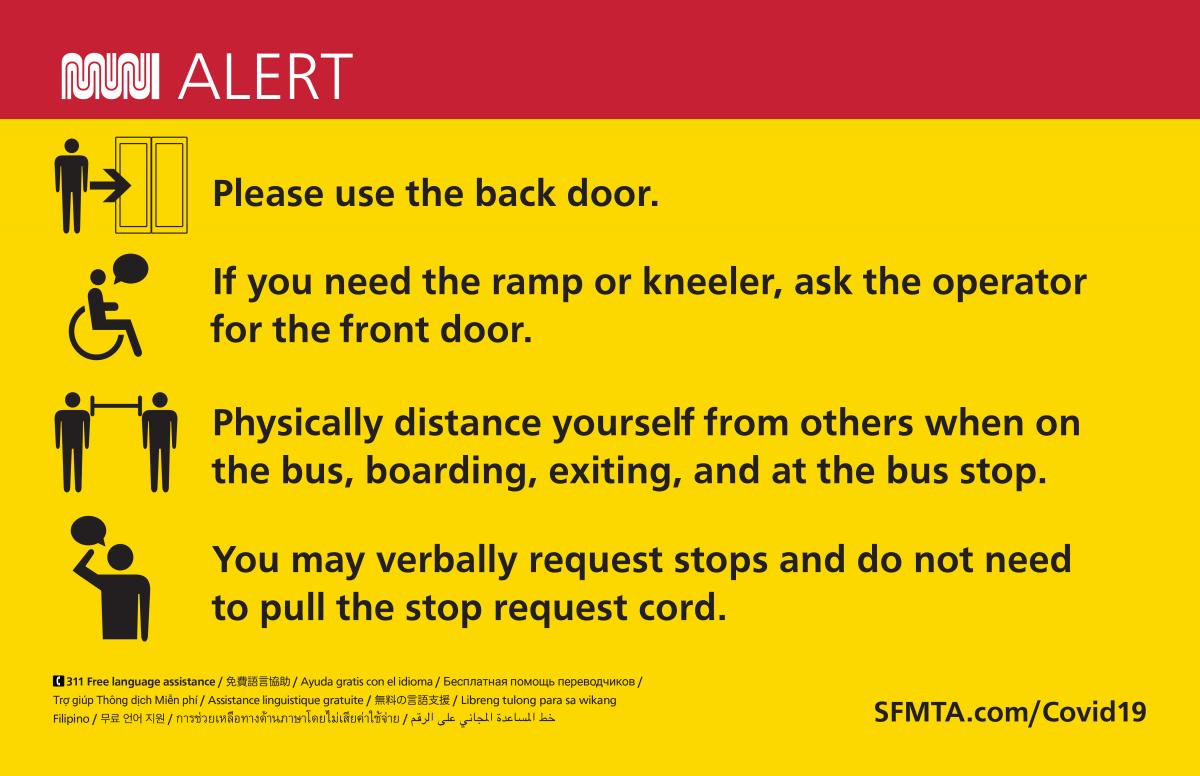
Last week we began requesting that all passengers board from one of the back doors unless they require assistance. People with disabilities and others who need the kneeling function of the bus can request boarding in the front from the operator. To help reinforce backdoor boarding and to help remind passengers about social distancing, new signs have begun going up in buses.

We’re also giving operators guidance about passenger thresholds for different vehicle types. If a bus becomes too crowded, operators can skip stops. And if needed, we’re prepared to quickly make changes to continue to support social distancing on our vehicles. We are monitoring capacity daily through automatic passenger counts and assessments from inspectors on the street. This gives us a holistic view of what is happening on the street so we can make adjustments as resources become available.

We are doing our part to reduce the risk of transmission on Muni, and we need San Franciscans to do their part too. Unlike normal times when we welcome and encourage all kinds of trip on Muni, during this public health emergency, we need San Franciscans to use Muni only for essential trips and only for trips that you can’t make by some other mode of transportation.

Please check the SFMTA COVID-19 Response page for the latest service and citation information. Or go to the SF.gov COVID-19 website for citywide resources about the shelter-in-place order.

Image of signs going into buses that says: Please use the back door. If you need the ramp or kneeler, ask the operator for the front door. Physically distance yourself from others when on the bus, boarding, exiting and at the bus stop. You may verbally request stops and do not need to pull the stop request cord. SFMTA.com/Covid19Signs are going into buses to encourage passengers to practice social distancing and use the back door for boarding.  


Published April 01, 2020 at 11:45PM
https://ift.tt/2WXrETv

Tuesday, March 31, 2020

Support San Francisco Small Businesses

Support San Francisco Small Businesses
By Sophia Scherr

As the coronavirus (COVID-19) continues to impact communities across the country and here in San Francisco, the San Francisco Council of District Merchants Associations (SFCDMA) is asking for your help in supporting small businesses and the people they employ during this unprecedented time.

What can you do to support your favorite San Francisco small businesses? The SFCDMA asks that you consider donating and sharing a recently-launched  GoFund me campaign with at least two other contacts to, encourage further online donations.

With the mandatory shelter in place order still in effect and the potential for it to be extended, local merchants such as your favorite clothing store, bar, café, restaurant, hair salon, gym or spa, are all entering a period of concern and jeopardy.

Donations will be passed directly to the SFCDMA member associations (see below) and will be distributed amongst the small businesses most in need. 100% of funds received will go to the neighborhoods listed. SFCDMA will pay all administrative fees. 

MERCHANTS ASSOCIATION MEMBERS:

Balboa Village Merchants Association
Bayview Merchants Association
Castro Merchants
Chinatown Merchants Association
Clement St. Merchants Association
Divisadero Merchants Association           
Dogpatch Business Association
Excelsior Outer Mission Merchants
Fillmore Merchants Association
Fisherman’s Wharf Merchants Association
Glen Park Merchants Association
Golden Gate Restaurant Association
Greater Geary Boulevard Merchants & Property Owners Association
Haight Ashbury Merchants Association
Hayes Valley Neighborhood Association Merchant Group
Ingleside Merchants Association
Inner Sunset Merchants Association
Japantown Merchants Association
Larkin Street Merchants Association
Lower Haight Merchants & Neighbors Association
Marina Merchants Association
Mission Merchants Association
Noe Valley Merchants Association
North Beach Business Association
North East Mission Business Assn.
People of Parkside Sunset
Polk District Merchants Association
Potrero Dogpatch Merchants Association
Sacramento St. Merchants Association
South of Market Business Association
The Outer Sunset Merchant & Professional Association
Union Street Association
Valencia Corridor Merchants Association
West Portal Merchants Association

Together, we can support and donate to San Francisco small businesses to help sustain these neighborhood merchant associations through these uncertain times. As a community, we can help to ensure that they and their employees emerge from this crisis to serve not only their customers but the communities that they love and operate in.


Published April 01, 2020 at 12:01AM
https://ift.tt/2UvqZH6

Thursday, March 26, 2020

SFMTA Budget: Revenue, Expenditures and Future Projections

SFMTA Budget: Revenue, Expenditures and Future Projections
By
The Coronavirus pandemic and current shelter-in-place order have changed our daily routines. The timeline for the SFMTA budget approval has not yet changed, and as such, we are taking steps to ensure we continue to engage in a thoughtful and comprehensive community process in light of the current circumstances. If you would like to comment on the budget, please email sfmtabudget@sfmta.com, call (415) 646-2222, or post on our Facebook page or Twitter using #sfmtabudget. You can also visit our budget webpage.

This is the second in a series of blog posts diving into the budget process. The first blog was a high-level overview. This post will discuss the state of our projected revenue and expenditures and how they inform budget development. Future blog posts will include content focusing on:

  • Policy objectives and funding priorities
  • Overview of our outreach
  • Adopted Budget and what it includes

Overview of the Budget

Our state constitution and the city charter both require balanced budgets. This means that as a department of the City and County of San Francisco, we must propose a two-year balanced budget where projected expenditures do not exceed projected revenue.

Revenue refers to the total amount of money that the SFMTA collects or receives, while expenditures refer to the total amount of money that the SFMTA spends to provide services and implement projects. There are two key challenges to be weighed by us, our city partners, and stakeholders when balancing the proposed budget.

  1. The SFMTA must estimate its revenue and expenditures as far as 24 months in advance. This is going to be particularly challenging given the uncertain economic outlook as a result of COVID-19.
  2. In many cases, the City Charter and state law restrict how revenue is generated and what collected funds can be spent on. For example, the recently passed Proposition D, a tax on ride-hailing companies like Uber and Lyft, mandates that half of revenue raised go to improving pedestrian and bicycle safety.

Operating Budget

The City Charter mandates that Muni operations, meaning daily service and maintenance, be delivered at specific levels. The funds required to meet the mandated operations levels come from the Operating Budget.

In Fiscal Year 2021 (July 1, 2020 – June 30, 2021), we expect our total Operating Budget to be $1.3 billion. As shown in the pie chart, we have four main sources of revenue: General Fund (34%), Parking and Traffic Fees and Fines (31%), Transit Fares (18%), and Operating Grants (17%).


Accessible test for Graphic #1

Over the past seven years there has been a meaningful decrease, in inflation-adjusted dollars[1], in two of the main revenue sources: Parking and Traffic Fees and Fines and Passenger Fares.

As shown in the graph below, these declining revenues make the SFMTA increasingly reliant on revenue from the General Fund and state Operating Grants to fund operating costs.


Accessible test for Graphic #2

The General Fund is the total pot of money that the City and County of San Francisco collects from taxpayers throughout the year. The City Charter sets a minimum level of funding from the General Fund that goes to the SFMTA.[2] State Operating Grants come from the State of California’s General Fund through various taxes, mostly on gasoline, and are allocated through various state and regional agencies such as the California Transportation Commission (CTC), California Department of Transportation (CalTrans), and Metropolitan Transportation Commission (MTC). The SFMTA General Fund allocation and state Operating Grants are fairly flexible revenue sources meaning that they can be used for a variety of operating and capital expenditures.

While these two revenue sources provide a large portion of the SFMTA’s overall budget, their size and stability are dependent on the state of the economy and corresponding tax revenues. Reliance on revenue sources that fluctuate with economic booms and busts means that economic downturns will force the SFMTA to reduce service. This is especially true as current revenue sources are expected to decrease significantly due to the Coronavirus pandemic and current shelter-in-place orders.

As our main revenue sources have decreased, the SFMTA also faces constantly increasing expenditures, because the costs of maintaining and providing service are increasing. Operating expenditures fall into two categories: labor and non-labor.

Labor expenditures (e.g. employee salaries) are increasing because we need to pay our staff more to keep up with the cost of living. Additionally, the agency’s pension contributions are increasing as the number of retirees increases. Non-labor expenditures (e.g. bus tires) are also increasing because equipment costs and software licensing fees have continuously grown.


Accessible test for Graphic #3

Increasing expenditures and decreasing revenue creates a structural deficit – i.e., revenue is not keeping up with costs. In booming economic times, the agency’s costs go up relative to the cost of living. Our revenue, however, increases slower – only as much as inflation. Overall, our deficit is projected to rise from $66 million in FY2020-2021 to $167 million by FY2024-2025.

Accessible test for Graphic #4

The SFMTA is proposing a suite of policy changes in this year’s budget to achieve our Strategic Plan goals and help address this deficit, consistent with our values. These policy changes are projected to impact revenue and expenditures, bringing the agency to a balanced budget for Fiscal Years 2021-2022. As noted above, our next blog post will discuss these policy objectives and how they align with our funding priorities and values.

Capital Budget

The funds required to build, maintain, and enhance transportation infrastructure -- the vehicles, the rail, and all the physical and technical needs of our transportation system -- are accounted for in the Capital Budget. For example, while the Operating Budget pays for transit operator salaries, the Capital Budget pays for new buses. In Fiscal Year 2021, the agency’s total Capital Budget is projected to be $468 million. This budget includes four main expenses: Transit Optimization and Expansion (31%), Fleet (26%), Transit Fixed Guideway Infrastructure (14%), and Streets (12%).

Creating the transportation system that San Franciscans deserve requires not only expanding and modernizing, but also investing in and improving the current system. Overall, the list of capital needs—the investments required to maintain and expand the current system to meet the SFMTA’s and the City’s transportation goals—far exceeds available funding. When developing the two-year Capital Budget, the SFMTA must consider all capital needs and make tradeoffs between maintaining and expanding our system.

The SFMTA’s medium to long-term projected capital needs for the city’s transportation system, detailed in the 20-Year Capital Plan, have grown by $8.9 billion, to a total of $30.8 billion in 2019. General sources of this increase include realities like the increased costs for constructing projects. For example, in 2016, the average cost to install a traffic signal at an intersection was $400,000. By 2018, however, this number doubled to $800,000. Additionally, cost estimates for streets projects have increased, because we have more of them and they are more extensive in order to meet Vision Zero goals and eliminate traffic fatalities in San Francisco. 

Along with escalating projected costs, the investments required to ensure that our current system functions at peak performance, known as the transportation system’s State of Good Repair (SGR) backlog, is growing. The SGR backlog is the replacement value of assets, like our buses, that are older than their estimated useful life. Between 2018 and 2019, the agency’s reported asset backlog rose to $3.23 billion due primarily to the agency’s aging facilities and parking and traffic assets.

As with the Operating Budget, capital expenditures required to reach our transportation goals are far outpacing available capital revenue. The chart below shows the broad categories of how the agency spends its capital dollars. The majority of the funds are spent on State of Good Repair (e.g. replacement trolley coaches, Islais Creek Facility rehabilitation), followed by Transit Optimization (e.g. Van Ness Bus Rapid Transit, Better Market Street), followed by Streets (e.g. Fulton Street Safety and Transit, Safer Taylor Street).

The chart also shows our expenditures on the Central Subway project. In FY17-21, the Capital Budget was $3.4 Billion. In FY 21-25, the Capital Budget is expected to decrease by approximately 30 percent to $2.4 Billion. This means that the number of projects that the SFMTA can deliver is expected to decrease. 


Accessible test for Graphic #5

There are three main reasons for the anticipated fall in capital revenue:

  • Central Subway Nearing Completion: a $1.6 billion subway extension connecting Caltrain, under Market Street to Chinatown, is nearly complete. This means that, unlike previous CIPs, we aren’t receiving any additional revenue for this project. 
  • General Obligation Bond (GO Bond): We have spent nearly all the $500 million of the City and County of San Francisco municipal bond passed by voters in 2014.
  • Prop K Sales Tax Expenditure Plan: while the tax itself doesn’t need to be approved again, periodically the voters must approve how these funds are spent. We have spent nearly all the funds approved in the current expenditure plan and must develop a new one.

Looking Ahead

We are facing an operating structural deficit as our expenditures steadily outgrow our revenue. Similarly, the Capital Budget is experiencing declining revenue just as the needs of our system are growing more than ever. These aren’t easily solved problems, but our city recognizes the need to deliver the transportation system that San Francisco deserves. In 2017, Mayor Ed Lee and then Board of Supervisors President London Breed convened Transportation Task Force 2045 (T2045). The task force was responsible for developing and evaluating options for how the city can generate additional revenue for our transportation needs. Several of the options explored by T2045 include:

  • Congestion Pricing: a fee paid to drive in designated congested areas. This option wasn’t considered as a revenue-generating tool but as a part of policy package to reduce congestion.
  • A Second Transportation Sales Tax: Proposition J and K went on the ballot in November 2016. Proposition J was a charter amendment that would dedicate funding that comes into San Francisco’s General Fund from the Proposition K sales tax measure which included a half cent for transportation. Unfortunately, the joint measures did not pass.
  • Transportation Network Company (TNC) Fee: a per-ride fee on TNC rides to help pay for congestion management efforts to mitigate the impacts of TNC trips

This past November one of these potential revenue measures, Proposition D, was approved by the voters. Proposition D is a tax on ride-share companies like Uber and Lyft to provide funding for both the Operating and Capital sides of the SFMTA budget. This tax is estimated to bring in $30 million dollars annually, with half going to capital investments for pedestrian and bicycle safety.

Several of the other revenue sources that might be up for consideration soon include:

  • A Second GO Bond: this revenue was not included in the current FY 2021-2025 CIP, a second $500 million GO Bond is scheduled to go to the ballot in November 2022
  • Reauthorize Prop K: reauthorizing Prop K by developing a new expenditure plan would provide funding to a wide array of our capital programs.
  • Community Benefits District: a tax district that allows communities to raise money for local infrastructure investments and services.

As the agency moves forward with adopting the next two-year budget, we need to continue the dialogue about revenue and expenditures. That includes adjusting to the new economic conditions we find ourselves in today and continuing to support the long-term financial health of the agency with new on-going revenue sources. 

Where to find additional information

In the upcoming weeks, we will be publishing additional blogs that will provide more detail on specific aspects of the budget process. For additional questions, please review the following documents or email sfmtabudget@sfmta.com.

  • Transportation Task Force 2030
    • In 2013, Mayor Ed Lee convened a Transportation Task Force to investigate what San Francisco needs to do to fix our transportation network and prepare it for the future. After a year of study, this committee found that to meet current need and future demand the city needs to invest $10 billion in transportation infrastructure through 2030. 
  • SF Transportation Task Force 2045
    • The Task Force's final report outlines the trade-offs facing our city's transportation system. The report will serve as a resource to help provide an understanding of these trade-offs in order to identify new revenue sources for our city's transportation system.
  • SFMTA 20-year Capital Plan (2017)
    • This is a fiscally unconstrained assessment of the SFMTA’s anticipated capital needs in the next 20 years. It identifies the investment needed to meet the agency’s and city’s transportation goals, and informs the capital side of each two-year comprehensive budget
  • SFMTA State of Good Repair Report (2018)
    • Our 2018 State of Good Repair Report provides an overview of the agency’s rehabilitation and replacement needs and investments. It also outlines the agency’s project prioritization, planning, and delivery practices related to maintaining a State of Good Repair.

Coming up next in our series: Policy Objectives and Funding Priorities


[1] Constant dollars is a term that refers to the inflation-adjusted value of a dollar. A dollar in 2020 is worth slightly less than a dollar from 2019 because of rising prices.

[2] This level of funding is adjusted for significant service level increases, like the opening of Central Subway


Published March 27, 2020 at 05:58AM
https://ift.tt/33SEqEm
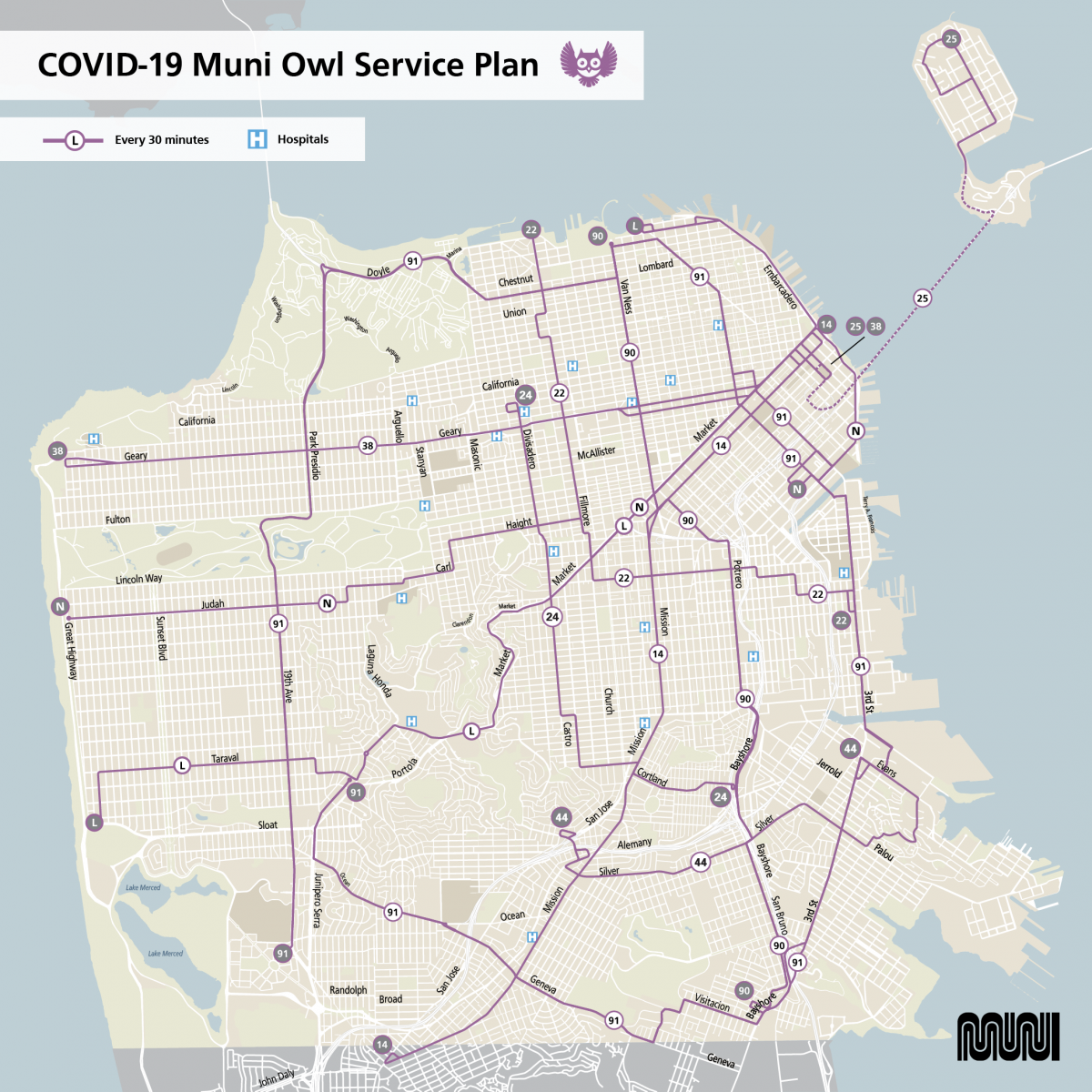
Photo Exhibit Event: Vintage Bus Display and Tour

Photo Exhibit Event: Vintage Bus Display and Tour By Jeremy Menzies Join us Saturday, Jan. 27 at a special event for our exhibit, " 1...