Tuesday, July 21, 2020

Improving Forest Hill Park and Realizing City Sustainability Goals

Improving Forest Hill Park and Realizing City Sustainability Goals
By Jay Lu

Thanks to agency partners, community support and Supervisor Yee, the Forest Hill Irrigation Improvement Project was completed in late June. This project aims to conserve water, increase biodiversity, and improve the park conditions at the Forest Hill transit station.

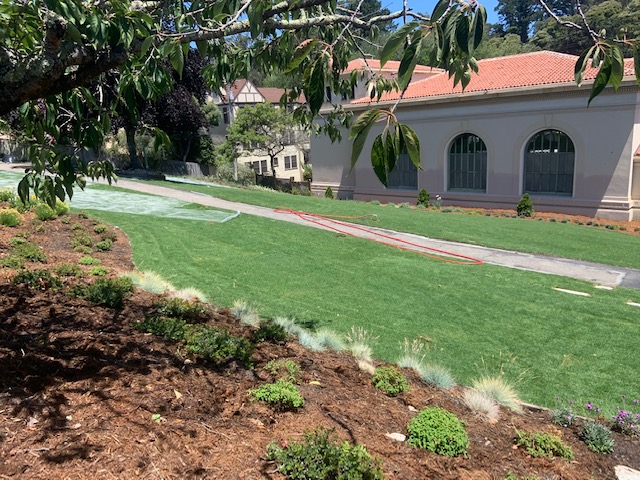
Forrest Hill Station with new sod and irrigation system

Funded by SFMTA and the San Francisco Public Utility Commission’s Large Landscape Grant Program, the project has upgraded the station area’s 40-year-old irrigation system and replaced the existing sod with a new variety that requires less water. The project also introduced drought tolerant and native plants selected with input from the community which will surround the historic Forest Hill station that opened to transit service in 1918.

In addition, a Nature Exploration Area was constructed as part of the project with funding and design by SF Rec & Park. The five-month construction started in February 2020. To give the new sod ample time to establish, the park will remain closed until mid-August.

By saving up to 442,494 gallons of water per year, the project, a multiple city agency collaboration by the SFMTA, SFPUC, Public Works and Rec & Park, supports citywide water conservation, biodiversity and sustainability goals at the Forest Hill Station.

The SFMTA wants to take this opportunity to thank our community partners, Supervisor Yee and our sister agencies for their support in shaping the design and moving the innovative project forward.

For more information, visit SFMTA.com/Foresthillirrigation


Published July 22, 2020 at 01:03AM
https://ift.tt/2WGO6zp

Monday, July 20, 2020

Muni Brings Service Changes to Both Bus and Rail August 22

Muni Brings Service Changes to Both Bus and Rail August 22
By Mariana Maguire

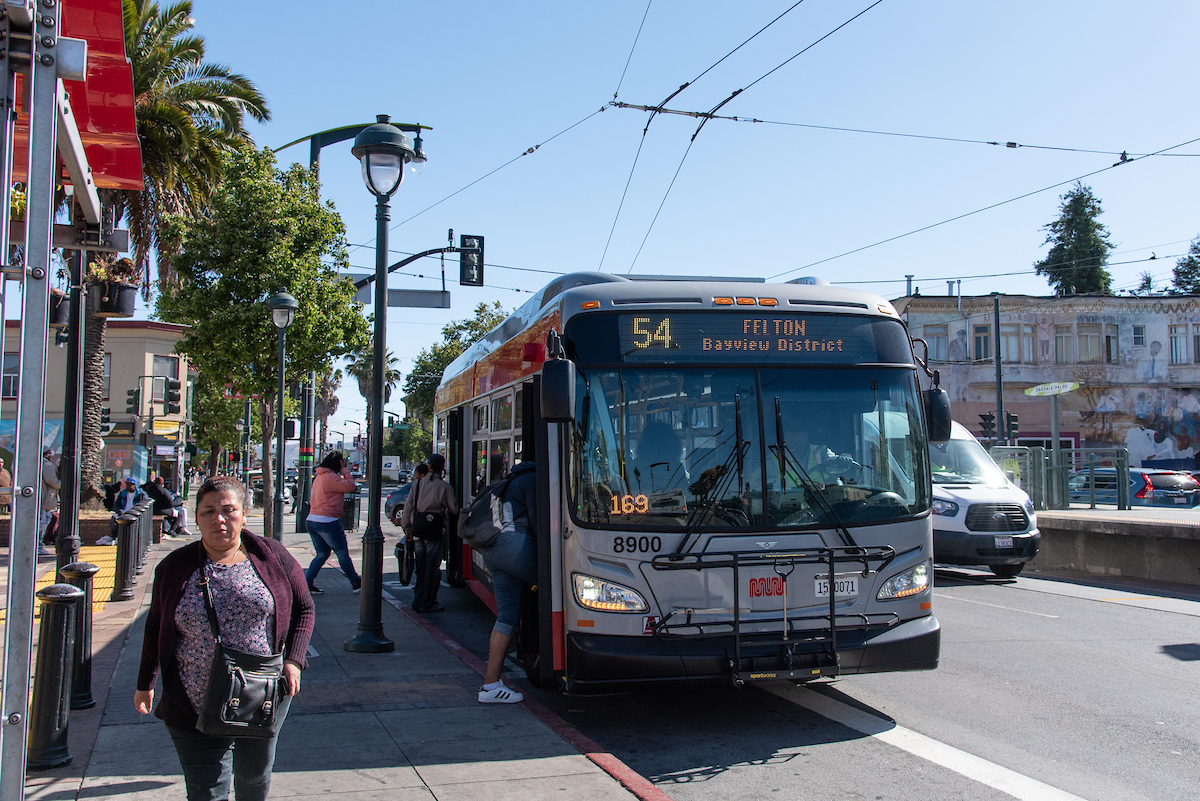
54 Bus picking up customers in the afternoon

Photo: 54 Felton bus serving the Bayview and several other equity neighborhoods from Hunters Point to Daly City BART

The SFMTA will bring back, extend and improve frequencies on several targeted bus routes to continue to support essential trips and physical distancing beginning Saturday, August 22, in addition to restarting modified Muni Metro service. These service changes will also support the city’s economic recovery by providing more connections to neighborhood commercial districts as businesses reopen. With the restart of Muni Metro, we can repurpose Muni buses that had been operating in place of rail lines to add service on other routes.

Below is a summary of upcoming service changes.

L Bus Construction Shuttle

  • A bus substitution will continue to provide service from SF Zoo to Sunset Blvd. related to L Taraval Improvement Project construction.
  • Eastbound towards West Portal Station: Transfer from L Bus to LK Taraval-Ingleside train at Taraval at 32nd Avenue
  • Westbound towards Wawona at 46th Avenue: Transfer from LK Taraval-Ingleside train to L Bus at Taraval at Sunset Boulevard
  • Daily Frequency: At most every 10 minutes

7 Haight-Noriega (Newly restored!)

  • The full 7 Haight-Noriega route is being restored between Ortega at 48th Avenue to Salesforce Transit Center
  • 60-foot buses will replace the 40-foot buses allowing more room for customers to maintain physical distance onboard and reduce pass-ups
  • Connections to Inner Sunset, the Haight and Downtown
  • Daily Frequency: Between 10 and 20 minutes

12 Pacific Community Shuttle (Extended)

  • A modified route will be extended between Jackson at Van Ness to Sansome at Sutter to provide connection to Market Street
  • Daily Frequency: Between 10 and 20 minutes

28 19th Avenue

  • Weekend service is being added for modified route between Daly City BART and California at 7th Avenue
  • Access to transfer points to UCSF, Kaiser and the California Pacific Medical Center
  • Daily Frequency: Between 10 and 20 minutes

30 Stockton (Extended)

  • The 30 Stockton route is being extended to Crissy Field at Mason in the Presidio, between 6:00 a.m. and 8:00 p.m. daily. All other times, the 30 Stockton terminal will be at Divisadero and Chestnut
  • 60-foot buses will replace the 40-foot buses allowing more room for customers to maintain physical distance onboard and reduce pass-ups
  • Connections to Crissy Field, Chinatown, Downtown and Caltrain
  • Daily Frequency: Between 10 and 20 minutes

37 Corbett (Newly restored!)

  • A modified route will go from Twin Peaks to 11th St at Market via Market Street
  • Connections to Castro, Church and Van Ness Muni Metro Stations
  • Daily Frequency: Between 10 and 20 minutes
  •  Service Hours: 6:00 a.m. to 9:00 p.m. on weekdays, 8:00 a.m. to 9:00 p.m. on weekends

44 O’Shaughnessy (Extended)

  • The full 44 O’Shaughnessy route is being restored between Hunters Point and California at 6th Avenue
  • Connections to Bayview, Portola, Glen Park and Forest Hill Stations, Golden Gate Park and the Inner Richmond
  • Daily Frequency: Between 10 and 20 minutes

45 Union-Stockton (Newly restored!)

  • The full 45 Union-Stockton route is returning between Townsend at 4th St to Lyon at Greenwich
  • Connections to SoMa, Downtown, Chinatown and Union Street
  • Daily Frequency: Between 10 and 20 minutes

48 Quintara (Newly restored!)

  • Modified route between 20th St at 3rd St to West Portal Station
  • Connections to West Portal, 24th St BART and Potrero Hill/Dogpatch. The route is simplified near Diamond Heights
  • Daily Frequency: Between 10 and 20 minutes

49 Van Ness-Mission

  • 60-foot buses will replace the 40-foot buses allowing more room for customers to maintain physical distance onboard
  • Daily Frequency: At most, every 10 minutes

54 Felton (Extended)

  • The full 54 Felton route is being restored from Hunters Point to Daly City BART
  • Connections to Bayview, Portola, Excelsior, and Balboa Park and Daly City BART Stations
  • Daily Frequency: Approximately 20 minutes

67 Bernal Heights (Newly restored!)

  • The full 67 Bernal Heights route is returning from Ellsworth at Crescent to 24th Street BART Station
  • Daily Frequency: Approximately 20 minutes

Improving Frequency

  • To reduce crowding the following lines will have more frequent service:
    • 8 Bayshore
    • 9 San Bruno
    • 9R San Bruno Rapid
    • 12 Pacific Community Shuttle
    • 14 Mission
    • 19 Polk
    • 22 Fillmore
    • 24 Divisadero
    • 25 Treasure Island
    • 28 19th Ave.
    • 29 Sunset
    • 43 Masonic
    • 44 O’Shaughnessy

We may be able to introduce some additional service changes in the fall, but looking further ahead, future service increases depend largely on additional revenue and the potential relaxation of COVID-19 distancing requirements.

The SFMTA’s revenues have fallen while costs of providing service have dramatically increased, largely due to the new physical distancing and cleaning requirements. The pandemic and the financial crisis mean the SFMTA must do more with less. Amid these deep budget shortfalls and public health capacity limits, our staff – especially our operators, cleaning crews, facilities staff, service planners, and COVID response team – have been working hard to restore more routes with resources, including staff, vehicles and funds, stretched thin.


Focusing on our customers, equity and efficiency as we restore service

To provide our customers with the best service we must reduce duplicate service and costly sources of delay. In deciding how service is restored, we are focused on:

  • Meeting ridership demands identified during the pandemic; and
  • Prioritizing service for people who need it most—our obligation is to serve people that depend on transit.

We have steadily restored service from the 17 core routes that were in place in April to 42 routes by August, retaining or returning full or modified service to:

  • All rail routes, with a new reconfiguration to improve reliability and time savings
  • Key Rapid lines like the 9R San Bruno Rapid, 14R Mission Rapid and 38R Geary Rapid with high ridership and crosstown service
  • Almost all our Frequent Service routes that have high ridership and provide important crosstown connections
  • Close to half of our Grid routes – our most common, regular service neighborhood routes – prioritizing those that provide important crosstown service  
  • Almost all the Owl network – late-night service traditionally from 1:00 a.m. to 5:00 a.m. but currently operating between the hours of 10:00 p.m. to 5:00 a.m.
  • And 29 of our 41 equity service routes — the August 22 service changes will improve transit access through all of the neighborhoods identified in Muni’s Service Equity Strategy. These neighborhoods rely on transit service the most based on the percentage of households with low incomes, private vehicle ownership and concentrations of people of color.

We continue to hear about overcrowding and pass ups on specific lines, which is why we are increasing frequencies and adding vehicles and operators to those routes. Because of physical distancing, it now takes three times as many vehicles to move the same amount of people as pre-COVID. This significantly limits the resources available to bring back additional routes. Our August 22 service changes will put close to the maximum number of available operators and vehicles out on the street to serve our customers. At the same time, our budget shortfalls prevent us from hiring more operators and cleaners or purchasing more vehicles.

As with everything else with this pandemic, our service allocation throughout the city beyond August is uncertain. The routes that are not being prioritized to bring back into service in the near term consist of routes that:

  • Provide parallel, duplicative, service to our existing network
  • Connector, historic and specialized routes, that are important and beloved, but provide shorter service to a smaller number of people

These service suspensions are temporary. Permanent long-term service changes would require additional analysis and public input. We look forward to engaging on these issues with our elected officials and communities.


COVID Rider Reminders

Help the city reduce COVID transmission rate  by continuing to stay at home except for essential trips. 

Please use an alternate form of transportation whenever possible – walking, biking, taxis or driving – to save a seat on Muni for those who don’t have other options. Our Essential Trips Card program is a cost-effective way for seniors and people with disabilities to use taxis instead of Muni. Carshares and micromobility options are also available. Visit our COVID-19 Developments and Response page for more information on alternative transportation options. If possible, opt to shop local.

If you do need to travel on Muni, give yourself extra time, wear a face covering and practice physical distancing. Remember, your trip may now include transfers and a longer walk, and your fare is good for two hours across multiple buses. 

Masks or face coverings are required on Muni. To avoid getting passed up, cover your nose and mouth with face cover or mask, give the operator a friendly wave, and be sure to board by the back door unless you require assistance.

Visit our COVID-19 Developments and Response page for the latest information about Muni routes in service or to explore alternate ways to get around the city. To provide feedback on any Muni service changes please use our Muni Feedback Form.


Published July 21, 2020 at 03:15AM
https://ift.tt/2CmmU1X

Thursday, July 16, 2020

The Third Phase of Slow Streets Rolls Out a Network

The Third Phase of Slow Streets Rolls Out a Network
By Benjamin Barnett

We are very excited to be moving forward with the third phase Slow Streets, which will connect new and existing Slow Streets together into a network that allows most San Franciscans to be able to access essential services and employment without being reliant on either a car or Muni.

With Muni’s reduced capacity due to COVID-19 physical distancing, an additional 30 percent of service on hold due to financial challenges, and congestion already reaching peak pre-COVID levels, Slow Streets and our bicycling network are key to supporting people getting where they need to go.

“In order to support further reopening of the economy, we need to make San Francisco more welcoming and accessible for people who want to travel on foot, bicycle, wheelchair, scooter, skateboard or other forms of micromobility,” said Jeffrey Tumlin, SFMTA Director of Transportation. “Slow Streets are critical infrastructure that attracts users of the full array of neighborhood demographics—including children, older adults, people with disabilities and people of color.”

Slow Streets have been wildly successful, and survey data indicates an 80 percent approval rating. The next phase of our Slow Streets program is now being reviewed and approved so we can expand the popular program more broadly across our city and make it accessible to all.

Traveling by car may feel more enticing in the COVID-19 era but driving takes up ten times as much space per person compared to travel by walking, biking and other modes. In addition, approximately one in ten car trips in San Francisco are under a mile and 46 percent are less than three miles – trips that for many are prime to be done in other ways given comfortable space. Taking short trips to neighborhood business corridors on foot or by bike is also a great way to support our local economy during these difficult economic times for small business.

Pending approval, the proposed Phase Three Slow Streets would install temporary barricades and signage at designated intersections along the following additional corridors:

  • 20th Street from San Bruno to Pennsylvania avenues
  • Arkansas from 23rd to 17th streets
  • Arlington from Roanoke to Randall streets
  • Cabrillo Street from 45th to 23rd avenues
  • Cayuga Avenue from Naglee Avenue to Rousseau Street
  • Clay Street from Arguello Boulevard to Steiner Street
  • Duncan Street from Diamond Heights Boulevard to Tiffany Avenue
  • Holly Park Circle
  • Mariposa from Texas to Mississippi streets
  • Minnesota from Mariposa to 22nd streets
  • Noe Street from 23rd to Duboce streets
  • Pacific Avenue from Steiner to Gough streets
  • Pierce from Hayes to Duboce streets
  • Tompkins Avenue from Andover Street to Peralta Avenue

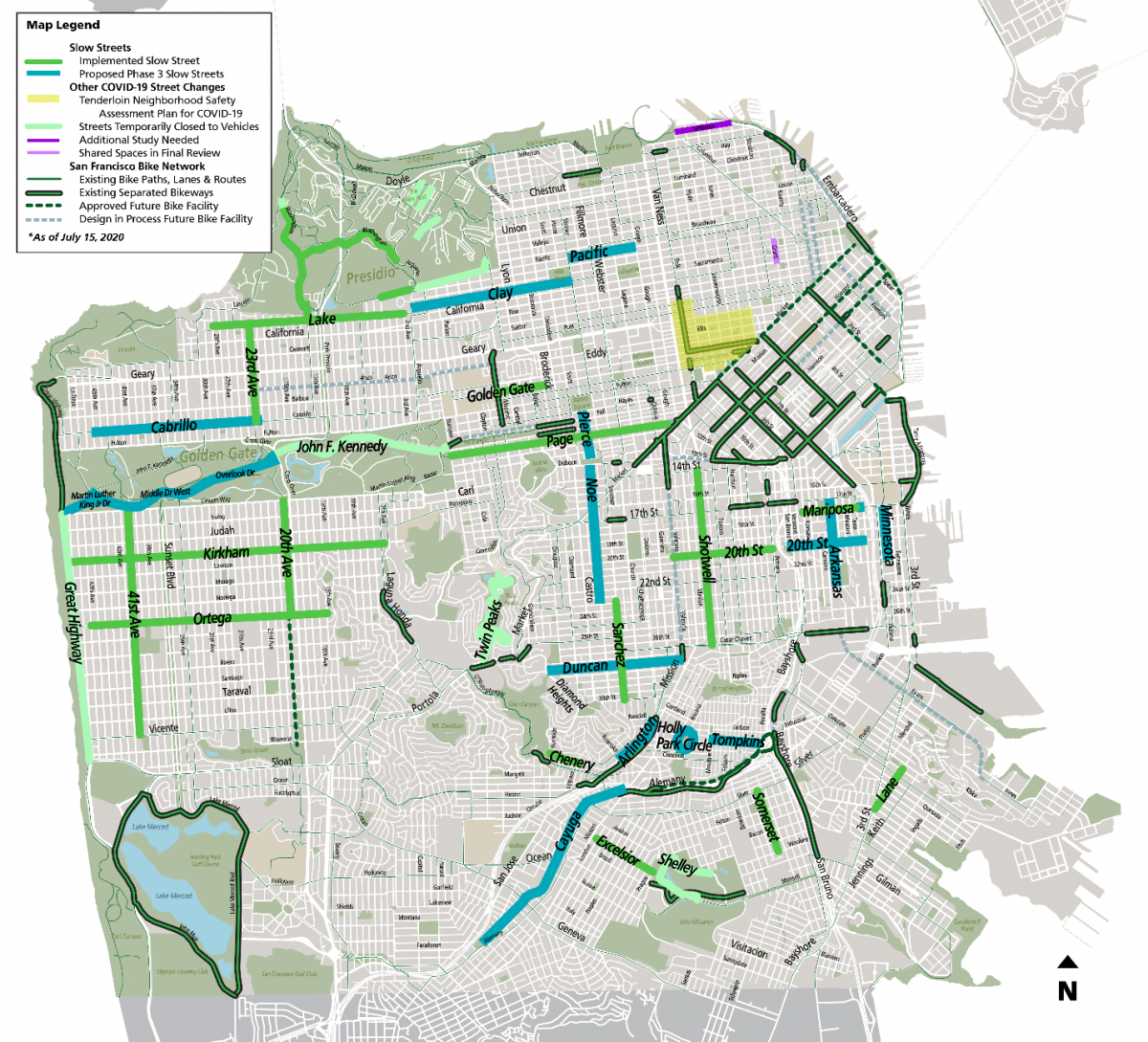
Slow Streets Map
Map of currently implemented and proposed Phase 3 Slow Streets along with a Shared Spaces street closure. Also included is our bike network highlighting separated bikeways, approved projects and those in the design pipeline.

We’re also interested in making sure all San Franciscans--particularly children from low income families--have access to open space. That’s why we’re extending the 30 Stockton to Crissy Field and creating a continuous, family-friendly path from the Panhandle to the Zoo. We are grateful for the support of Rec & Park for helping us allocate space in Golden Gate Park so that more San Franciscans can safely access open space, especially given the unique COVID-19 transmission science.

“Having room to safely exercise outdoors is critical for our mental and physical health,” said San Francisco Recreation and Park Department General Manager Phil Ginsburg, "Golden Gate Park is an oasis for socially distant recreation and I am thrilled this phase of Slow Streets extend a car-free path of travel all the way to the ocean.”

Shared Spaces

Our map also highlights two full street closures in final review as a part of the Shared Spaces program. This program allows businesses, merchant groups and community organizations to apply to open streets to support business activities as part of COVID-19 economic recovery. This includes full street closures or changes like repurposing parking in front of a business. Some possible uses include outdoor seating for cafes and restaurants, retail displays, or sales and service offerings.

Starting this Saturday, July 18, Grant Avenue between California and Washington streets in Chinatown is to be open for community activity on weekends from 9:00 a.m. to 8:00 p.m. There are more Shared Spaces applications being analyzed throughout the city and we will continue to support local business activities through this innovative program.

What’s Next?

We’ve been tailoring our approaches to the needs of each neighborhood and supervisorial district. In District 3, for example, we’ve been focused on Shared Spaces to help merchants and restoration of Muni service to neighborhoods with the highest transit demand in the city. In Bayview, Hunters Point, and Visitacion Valley in District 10, we’ve been focused not only on restoring pre-COVID Muni service, but also in-service transit improvements to neighborhoods most lacking in local services, and in the greatest need of access to employment and other opportunities.

Slow Streets Project Background

Within weeks of the mayor’s declaration of shelter-in-place directive, the SFMTA began planning for and implementing temporary emergency Slow Streets to provide additional space for physical distancing during essential active transportation trips. These Slow Streets were approved through the city’s emergency operation command system, including review from other agencies across the city, and with an emergency statutory exemption under CEQA. They were implemented with temporary barricades and signage at designated intersections to identify the street as a shared space for vehicles, bicycles and pedestrians.

The Slow Streets Program is intended to allow roadways to be used as a shared space for foot and bicycle traffic with adequate space for travelers to maintain six-foot separation. This space is needed for essential walk and bike travel while transit service levels are temporarily reduced. Vehicle traffic is allowed on these streets but is limited to local traffic (e.g. access for residents and visitors of residents), mail, delivery services and emergency vehicle access. Collectively, the bicycle network, Slow Streets, Shared Spaces, and our existing sidewalk system provides more options for many.

Slow Streets don’t work everywhere. Successful Slow Streets generally have these qualities:

  • Approximately 6-8 blocks long
  • No more than two lanes, preferably one in each direction
  • Residential areas
  • Mostly flat
  • Connections to bike lanes and parks
  • Stop sign-controlled intersections, 4-way stops are best
  • No Muni, commercial loading or emergency route conflicts

Slow Streets does not legally change the designation of the public right-of-way; people walking or running in the street are allowed to be in the street as the California Vehicle Code currently permits, but people walking or running are required to yield to vehicular traffic.

Slow Streets are for essential trips, not neighborhood gathering points. We also encourage everyone to follow current health guidelines, bring a face covering and maintain proper physical distance from people outside their households. 

For updates, additional information and to provide input on the SFMTA’s Slow Street Program, visit the program webpage at SFMTA.com/SlowStreets. Please also visit SFMTA.com/COVID19 for the latest agency updates about our COVID-19 response. 


Published July 17, 2020 at 12:30AM
https://ift.tt/2OsAFP0

Tuesday, July 14, 2020

New Muni Metro Map Debuts to Support Major Railway Changes in August

New Muni Metro Map Debuts to Support Major Railway Changes in August
By Jeanne Brophy

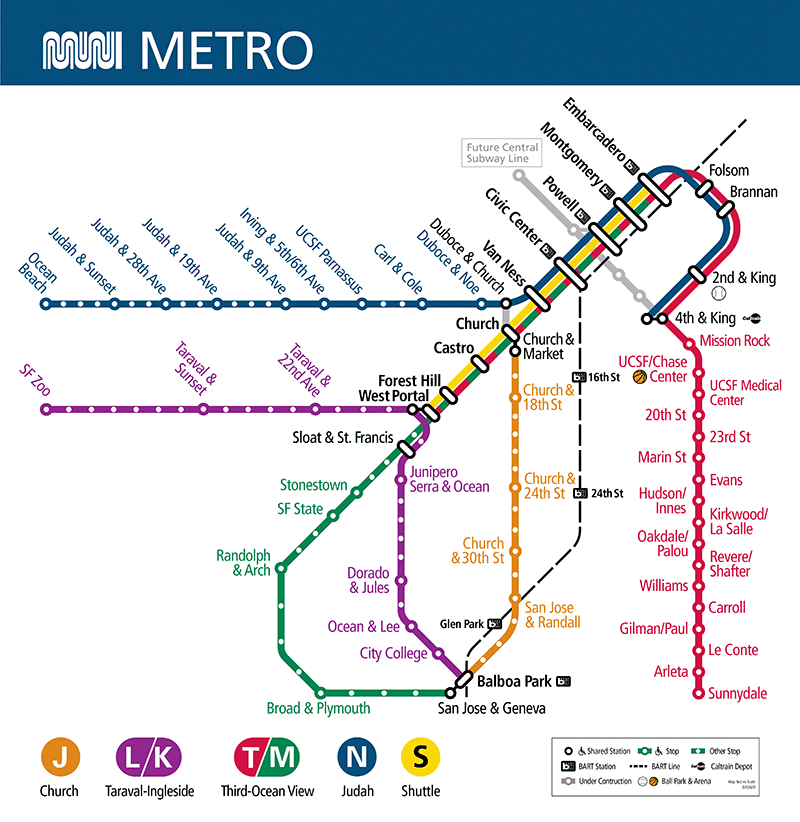
New SFMTA Muni Metro Service Map

As part of the Muni service changes scheduled for August we’ve moved forward with applying the upcoming changes to the Muni Metro system map to provide a visual reference.

As a temporary emergency measure, the L Taraval and K Ingleside will become one line at West Portal. This practice, known as “interlining” in transportation planning, will result in a new line; the LK Taraval-Ingleside. The line will no longer enter the subway at West Portal station and, as a result, West Portal will become a significant transfer point.

The LK Taraval-Ingleside route will run on the surface between the SF Zoo and City College at Balboa Park Station. At West Portal, LK Taraval-Ingleside customers traveling to points downtown will exit the train on the surface at West Portal and Ulloa and enter the station to transfer to the new temporary TM Third-Ocean View line or S Shuttle. Customers transferring from the subway will be directed towards the L-portion (westbound) or the K-portion (eastbound).

Other changes you see in the map include:

  • The LK Taraval-Ingleside line will use one color to ensure customers understand that the journey from the SF Zoo to Balboa Park can be completed without changing trains.   
  • Accessible transfer stops are highlighted with black outlines.
  • Church Street Station will be the new transfer point for the J Church. Customers will disembark on Market St. and go underground to transfer to the subway for points downtown or exit the subway to the street to head towards Balboa Park.
  • The TM Third-Ocean View line will also be combined however, instead of using one color it is still split into two colors to indicate that eventually the T Third will join the new Central Subway.
  • New frequent service with the S Shuttle is now indicated on the map to highlight its availability in the system.  
  • BART connections have been included as part of the city rail network given that customers also make use of the service and allows for an alternate transportation choice for quick trips within the city, along with its regional transportation role.

We are interested in hearing from you on these new, temporary system changes. We will work with the community to evaluate and make any adjustments that are needed to the temporary configuration based on public feedback and data monitoring. Please use our feedback form and tell us what you think.


Published July 14, 2020 at 10:24PM
https://ift.tt/2DH4wB8

Friday, July 10, 2020

The Future of Transit Service Through the Health and Budget Crisis

The Future of Transit Service Through the Health and Budget Crisis
By Jeffrey Tumlin

The pandemic has upended every aspect of our society, and the SFMTA is no exception. The COVID-related health and financial crises have resulted in deep and painful cuts to Muni service. We will be draining our fund reserve and spending one-time money just to sustain the service we have. Absent new outside funding, we fall off a financial cliff in 2023, just as the city needs us the most to support its economic recovery. As your Director of Transportation, I want to be open and transparent about how we got here and what it means for you.

When I took this job six months ago, our mobility systems were strong but inefficient, the result of too many years of avoiding hard or politically unpopular choices. This crisis has now forced us to make those hard choices. It has also demonstrated the SFMTA workforce’s depth of talent and creativity, and its capacity for collaboration and strategic risk-taking. The effects of this crisis will continue for years, and so I’m pushing all of us to learn from our successes and failures. Our approach is simple: be thoughtful and strategic and try new things without fear; listen carefully to feedback;  quickly adjust what we are doing if it is not working; and, build upon the experiments that succeed.

Pandemic’s Impact

At the pandemic’s onset, health concerns among our drivers and front-line workers coupled with a massive drop in ridership and fare revenue necessitated that we cut back Muni service dramatically. To help fill in the transit service gaps, our agency has rapidly rolled out new programs and promoted existing programs to respond to the need of San Franciscans for additional mobility options:

  • Slow Streets, expanding spaces for walking, cycling and playing;
  • The new Essential Trip Card that helps many people with disabilities and older adults access discounted taxi rides;
  • The Department of the Environment’s Essential Worker Ride Home program, and
  • The Shop-a-Round subsidized taxi ride to help seniors and people with disabilities get to and from the grocery store.

Because of the financial impact of COVID-19 on so many San Franciscans, the SFMTA, the mayor and the Board of Supervisors came together and agreed not raise transit fares for the coming two years. However, this decision contributes to our dire financial outlook and requires tough tradeoffs about which services the agency can continue to provide or how quickly we can provide them. 

The combined pandemic and financial crisis mean the SFMTA must do more with less. We are doing everything we can to save money while maintaining as much of our service as possible. This means: 

  • Eliminating most unscheduled overtime work;
  • Reducing the purchasing of goods and services to just the immediately needed essentials;
  • Significantly slowing down hiring; and,
  • Creating emergency temporary transit lanes to maximize the amount of service our buses can provide in the face of rising car congestion (read more about the data here).

Restoring Transit Service

As the economy slowly reopens, we are bringing some of the transit service back. In May and June we increased service, and by mid-August we expect to have additional service hours restored. However, the SFMTA won’t be able to restore more than 70 percent of pre-COVID service hours for at least the next six months, and probably even longer. 

With physical distancing requirements, we need three times the number of vehicles to move the same number of passengers. This means that even with 70% of service hours, our riders may feel like there is only 20 or 25 percent of our pre-COVID service available, because buses quickly reach their capacity limit. This results in essential workers being passed up at stops, even though we are offering better frequency and reliability on our highest ridership line than we had pre-COVID. When Metro Muni service returns in August, we will be deploying close to the maximum number of available operators and vehicles to serve our riders. Unless we are able to use those vehicles to carry more people, we will not be able to increase service any further.

Even if physical distancing constraints were relaxed, SFMTA would not be able to return to full transit service in the near future. This is because pre-COVID, the agency was already short on the number of operators needed to provide the scheduled service levels and our budget crisis prevents us from filling those positions or from backfilling positions that become vacant. Moreover, the health crisis means more of our employees are on long-term leave. 

In deciding how the 70 percent of service is restored, we are focused on:

  1. Meeting ridership demands identified during the pandemic; and
  2. Prioritizing service for people who need it most—our obligation is to serve people that depend on transit for their daily survival. 

We are working hard to make sure that we are serving all communities, particularly low-income and minority populations, and neighborhoods with the least access to services. With limited resources, providing better service to those who most need it requires service to those with the most choices. While we cannot bring back 100% of the prior Muni service levels, what we can do is bring service back in a way that shifts resources to routes most heavily used by those who depend on transit. Real equity work requires difficult trade-offs. Equity has long been a goal of the SFMTA, but under COVID it is a necessity. 

First, we cannot reinstate overlapping transit service in one part of town, while neglecting to serve another. In areas where we have duplicative service, we need to refocus those routes to improve overall city access, making sure we take care of riders that don’t have another option. Some Muni lines will see higher service levels than before the pandemic while others may not return.

Second, when Muni Metro service starts up again in August, it will be different. While we want to restore as much coverage as possible, we simply cannot afford to run every train to their full prior length, only to have them become stuck underground due to the congestion caused when all lines converge in the subway, increasing risk of exposure to COVID-19. We can provide the same access and significantly decrease expensive delays by running fewer, longer trains in the subway and keeping some routes above ground with transfers to the quick subway service. 

In the long term, of course, the subway should be modernized to run more trains, but those investments have been cut back for now because of the budget crisis. This plan will keep trains moving, though we know transferring between surface and subway trains will be an inconvenience and an adjustment

Finally, as with everything else with this pandemic, how our service is allocated throughout the city beyond August is uncertain. It will depend on the physical distancing requirements and revenues. We are making many temporary changes to adjust to rapidly evolving circumstances. We know that permanent long-term service changes will require additional analysis and public input and we look forward to engaging on these issues with our elected officials and communities. 

These are hard choices that involve trade-offs. But they are the right way to provide core service in the face of these immense challenges.

A Path Forward

This crisis is reshaping the services every San Franciscan depends on. Our budget will get us through the coming months, and for those who crave more details, our agency created a COVID-19 Data Analytics Dashboard, and you can see our budget presentation here.

But for us to break through this crisis, restore more service and expand progressive and innovative policies, we’ll need more resources.

The federal government, through the CARES Act, bought us time. But the money only covered the pandemic’s immediate impact and without further action by Congress, our city is on its own.

We, as San Franciscans, own the Muni system and the rest of the transportation network. As the owners of it, I know we need it to be equitable, efficient and safe. We need the transportation system to help our city correct for many inequalities, including growing income disparities, and support the economic recovery of all San Franciscans. Across city agencies, there is work being done to sow the seeds for a resurgence of neighborhood life and vitality -- transportation is a key part of doing that. 

I, and the SFMTA team, are the stewards of these goals and are committed to working with all of you on finding creative solutions, including financial ones, to deliver a system San Franciscans are proud to own. To this end, we are committed to:

  • being thoughtful in trying new things and not letting the fear of imperfection keep us from trying new things, listening to feedback, and quickly adjusting what we’re doing if it is not working;
  • Making tough decisions now to avoid expensive fixes later, and being transparent about what these decisions and trade-offs are; and,
  • Identifying new funding sources to keep our transportation moving over the long run. 

I know that change is hard, particularly during these uncertain times when we’re having to make so many adjustments across all aspects of our lives. I am confident that we can work through these adjustments together and build a stronger transportation system worthy of San Francisco’s legacy.


Published July 11, 2020 at 01:07AM
https://ift.tt/322PMqk
Thursday, July 9, 2020

Return of Muni Metro Rail FAQs

Return of Muni Metro Rail FAQs
By Mariana Maguire

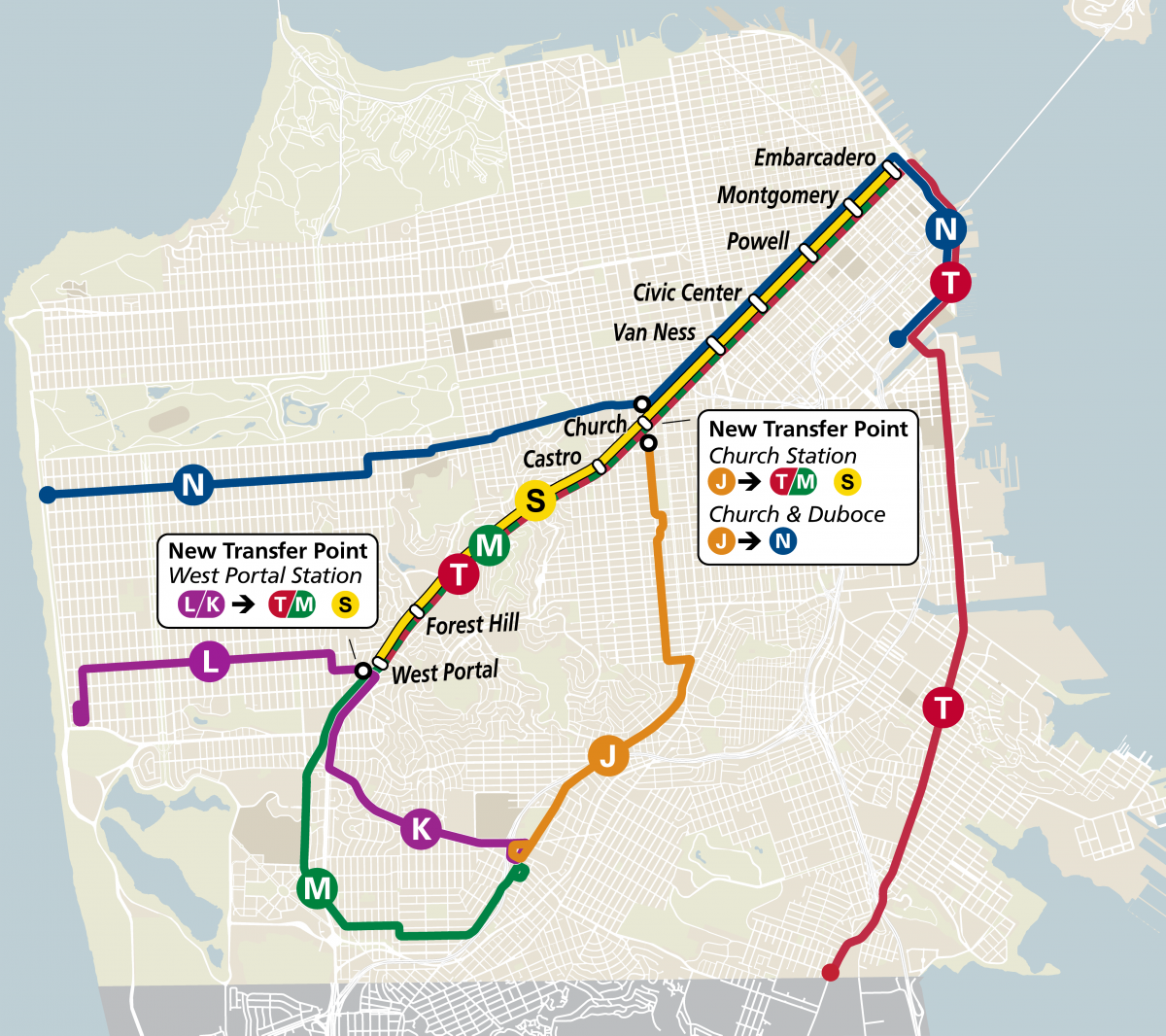
New rail map

Map: Proposed new Muni Metro rail configuration.

Recently, we shared the exciting announcement that Muni Metro Rail service will return in August with some time saving changes. For some customers, this is a big change and we know there are lots of questions! So, we complied answers to some of the most frequent ones we hear.  

Stay tuned for more information as we prepare to deliver more reliable, efficient rail service back to San Francisco. And please remember that Muni is still for essential trips only. You can help reduce crowding on transit by using other transportation options if they are available to you, like walking, biking, or our Essential Trip Card program. Unless you need to take transit for work, stay local and support your neighborhood businesses as they reopen.

How are Muni Metro Rail routes changing and will any routes be eliminated?

None of the Muni Metro rails lines are being eliminated. Rail service is returning in full, with some changes to the configuration to fix the chronic delays caused by our overburdened single subway tunnel where all the lines converge.

  • The L Taraval and K Ingleside surfaces lines will be combined into one line referred to as the LK. This means the L Taraval will still run from the SF Zoo to West Portal Station, where it will continue as the K Ingleside to Balboa Station via Ocean Avenue. The K Ingleside trains will do the same, running towards West Portal from Balboa Station before continuing on the L Taraval line to SF Zoo.
  • Customers on the LK heading towards downtown can transfer to the S at West Portal or to the TM at Saint Francis Circle.
  • The J Church will continue to run from Balboa Park Station to Church and Market but will terminate at Church and Market and turn around instead of entering the subway. Customers heading downtown can transfer to the TM or S in the subway or other above ground transit nearby.
  • The M Oceanview and T Third will now be combined from West Portal to Embarcadero.

We are currently safety testing three-car trains for the S Shuttle running from the Embarcadero to West Portal Station.

As a result of these changes, we expect customers will experience much more reliable and efficient service with far fewer delays along each leg of their trip.

Where will the transfer points be?

With the new temporary rail configuration, customers on the L Taraval or the K Ingleside continuing downtown will transfer at West Portal Station to the new all-day S Shuttle that will operate exclusively underground from West Portal to Embarcadero.

LK customers can also transfer to the TM line at West Portal Station to get downtown. This configuration will reduce delays and congestion in the tunnels, making service more reliable throughout the rail system.

For those who want to minimize the distance between transfer points St. Francis Circle is a great place to switch between the LK and the TM. This stop has accessible ramps inbound and outbound that serve both the LK and the TM.

J Church customers continuing downtown will transfer at Church and Market to the subway.

We expect fewer delays at these transfer points because trains will no longer suffer chronic back-ups from subway congestion.

Will transfer points be accessible?

Yes. We are currently working on two capital improvement projects to facilitate our proposed new rail configuration – the West Portal LK Transfer Project, and the J Church Transfer Improvements Project. The goal of these projects is to make the new transfers accessible. Project teams are working with local communities to test the placement and design of accessible ramps at Ulloa and updates at Market and Church. St. Francis Circle, another transfer point for the LK, also has accessible ramps.

As always, please plan some extra time when riding Muni – buses or rail – for unexpected situations and to allow for physical distancing requirements.

Will there be wayfinding signs and outreach to help customers understand the changes?

Yes. We are developing new subway maps and wayfinding signs. We will post knowledgeable ambassadors at transfer points and key stops to help direct customers. We will also install information inside our buses and trains before and after rail service restarts, and new onboard announcements will remind customers of the new transfers points.

Other outreach includes:

  • Sending multilingual mailers to residents near the L Taraval, K Ingleside, J Church lines and citywide;
  • Working with merchant groups, community-based organizations, Supervisor offices and neighborhood associations to get the word out among diverse communities;
  • Offering public presentations on the Transfer Improvement Projects and temporary rail changes;
  • Placing multilingual ads in citywide and neighborhood newspapers, TV and radio in multiple languages;
  • Emailing customers who signed up for updates on our projects;
  • Social media campaigns.

How can the public provide input?

The new rail configuration and the related Transfer Improvements Projects at West Portal and Church & Market are temporary. The goal is to identify permanent solutions to chronic subway delays and make Muni Metro more reliable, both inside the subway and on the surface. We plan to implement the new configuration and test its effectiveness. As always, customer feedback will be a key consideration in our decision making.

Public Meetings: The West Portal LK Transfer Project will host a public meeting on July 18 during which the public will have the opportunity to provide comment. Be on the lookout for a similar meeting to be scheduled for the J Church Transfer Improvements Project. These are capital projects, which require formal public input.

We have heard feedback from customers about the inefficiency of the subway, delays getting trains through the tunnels, and the need to improve reliability of Muni Metro rail. As we try out the new configuration, we will continue to take customer feedback into account, as well as ridership data, and delay statistics. To share your feedback as temporary rail changes roll out please email SFMTA.com/Feedback.

Why are these changes necessary?

Unlike many major cities, San Francisco’s subway has been over capacity with six rail lines trying to use one tunnel that can only accommodate turnarounds at the end points. Just like on a highway or roadway, as more vehicles use the space, the space becomes crowded and vehicles can’t move.

We temporarily suspended rail service due to COVID-19 health concerns and related staffing shortages. Now that we have a mobile cleaning program and more operators back at work who are certified to operate Muni Metro light rail vehicles, we can restore rail service in full. By trying out a new configuration of rail service, we expect to reduce the long delays that customers used to experience, stuck at or between stations.

Does this mean more people will be able to ride the trains during COVID-19?

Customers must still adhere to citywide physical distancing guidelines while riding Muni Metro rail. And, face coverings are required to ride Muni and while waiting at stops.

We are working with experts at the San Francisco Department of Public Health to add capacity to our vehicles as appropriate.

How often will trains run and what’s the schedule?

Trains will run seven days per week at frequencies of ten minutes or less. We are coordinating scheduling details and will release more information before the August service changes go into effect.

Now that you’ll have more buses available, what other routes will be coming back?

We expect several bus routes to come back in August along with the return of Muni Metro rail.

By bringing back rail we can:

  • Repurpose our buses for more routes
  • Put our longer buses into service on different routes to reduce crowding where there is high rider demand
  • Improve route frequencies on many lines so customers don’t have to wait as long for a less crowded bus
  • Use our resources more effectively

We are finalizing the details of each route that will come back into service and will provide a complete list of those updates soon.

Will customers still be required to wear face coverings?

Yes. Every customer is required, by the Mayor’s order, to wear face masks in public – including while riding Muni and waiting for a Muni vehicle.

Public health information is increasingly showing that widespread and consistent use of face coverings reduces the spread of COVID-19. We urge customers to take this seriously and have instructed our operators to pass up customers who are not wearing face coverings at Muni stops.

Remember: your face covering or mask protects others, and theirs protect you.

I got you covered mask poster


Published July 10, 2020 at 12:52AM
https://ift.tt/3ef2lkO

Thursday, July 2, 2020

Active Beale Improves Connection to Salesforce Transit Center

Active Beale Improves Connection to Salesforce Transit Center
By Enrique Aguilar

A series of transportation improvements on Beale Street will kick off this summer with a new transit lane from Market to Natoma streets. Transit lanes are part of the first phase of the Active Beale Street Project, and installation is scheduled to begin later this summer. The project was unanimously approved by the SFMTA Board of Directors on June 16, 2020 and received wide support from community members who participated in the meeting. 

The project aims to promote active transportation in the East Cut neighborhood as it continues to grow. Other Quick-Build changes coming to Beale Street this summer also include a two-way protected bike lane track between Market and Natoma, and a pickup/drop-off zone between Howard and Folsom. An extension of the two-way bike lane from Natoma to Howard streets and additional sidewalk widening on Beale Street would take place during construction phase one and two, which is expected to begin in late 2021. 

As the City gradually reopens, the SFMTA is implementing improvements like this one for San Franciscans to reach their destination using different modes of transportation and  allow for more physical distancing. 

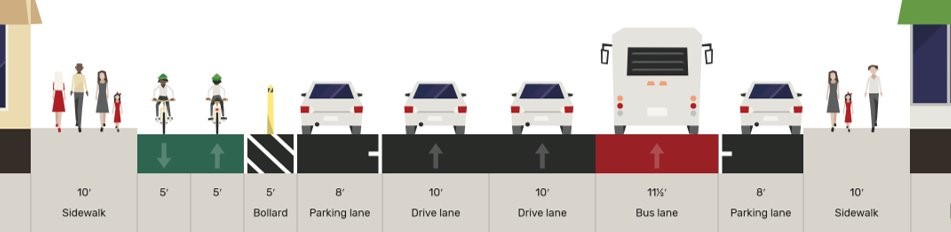
Proposed design: Beale Street, Market to Mission, looking South

Diagram below shows the future design for Beale Street, Market to Mission, looking South.


A Faster Connection to the City’s Transit Hub 

In a neighborhood composed of high-rise office buildings and affordable housing, transit lanes allow East Cut residents and those traveling downtown to complete their trips in less time on Muni and Golden Gate Transit, especially as we are seeing congestion returns to city streets. The Beale Street transit lane keeps Muni a reliable option for people who depend on transit so that employees can get to work, and customers can access shops and services. Commuters connecting to other regional transit lines at the Salesforce Transit Center would also see improvements in travel times and frequency. Beale Street is used by six Muni lines, including the 5 Fulton, 5R Fulton Rapid, 7 Haight-Noriega (shortened), 38 Geary, 38R Geary Rapid, 30X Marina Express (suspended), 41 Union (suspended), and Golden Gate Transit.

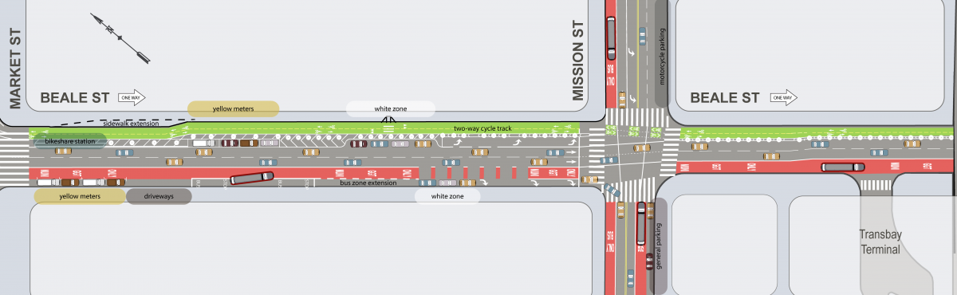
proposed transit lane between Market and Natoma

Diagram illustrates future transit lanes on Beale Street between Market and Natoma.

Transit lanes benefit Muni customers by reducing crowding and helping maintain physical distance onboard. As San Francisco’s economy continues to recover, it has become critical during COVID-19 to protect the health of Muni passengers by enacting physical requirements that have reduced passenger capacity across our transit system. With transit lanes, Muni will be able to complete routes in less time and return into service more quickly. This enables us to provide more service with the same number buses to reduce crowding and pass-ups.  

Customers also reduce their possible exposure to COVID-19 when their travel time is shortened. The SFMTA is developing a plan to install temporary emergency transit lanes as a temporary measure. These proposed lanes benefit customers on Muni routes that are critical to neighborhoods with high percentages of people of color and low-income households.  

Installing a transit lane on Beale Street this summer as a Quick-Build before the larger construction will improve travel times, frequency, and reduce possible exposure to COVID-19 for Muni passengers. Be on the lookout for other future improvements on Beale Street that will provide better protection for people who walk and bike to encourage other modes of transportation and help maintain physical distancing.  


Published July 03, 2020 at 01:27AM
https://ift.tt/3dVRXyi

Photo Exhibit Event: Vintage Bus Display and Tour

Photo Exhibit Event: Vintage Bus Display and Tour By Jeremy Menzies Join us Saturday, Jan. 27 at a special event for our exhibit, " 1...