Saturday, May 16, 2020

The Next Phase of Slow Streets

The Next Phase of Slow Streets
By

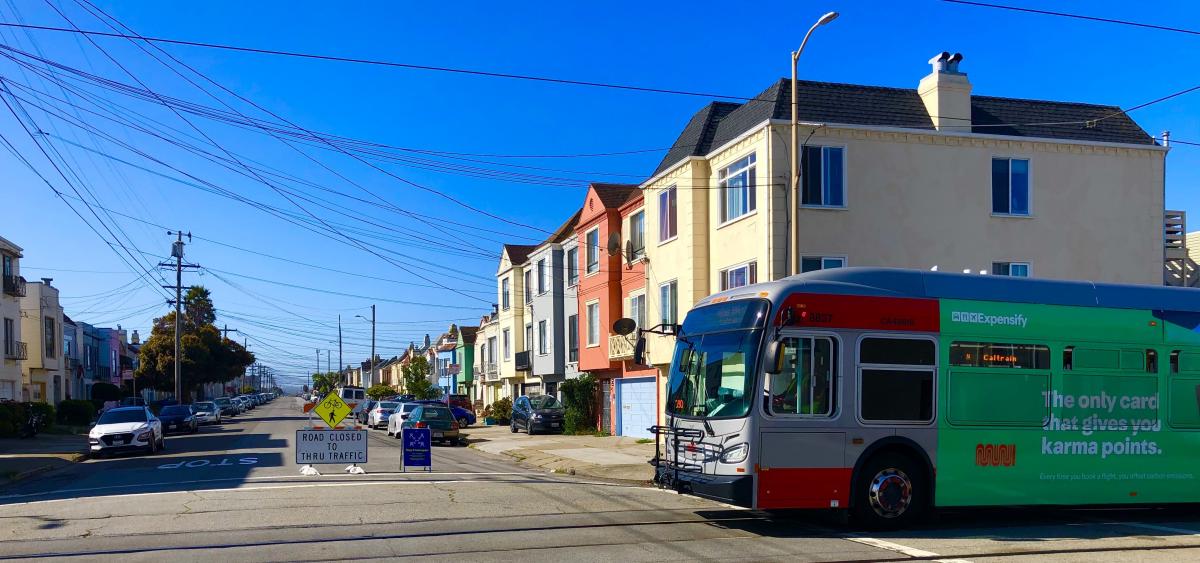
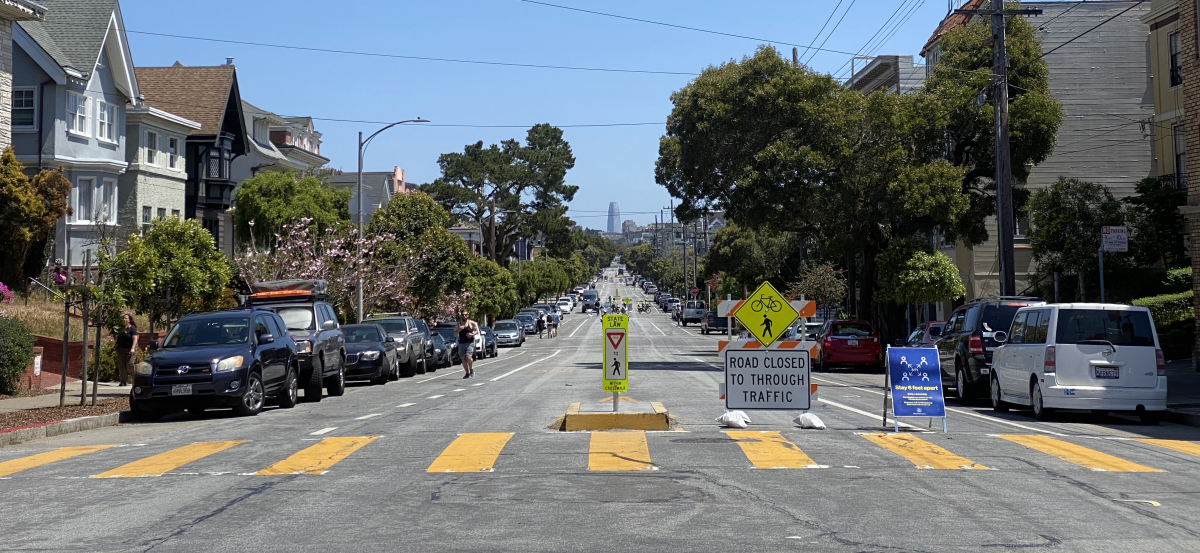
Slow Streets on Lake Street

Due to the COVID-19 health crisis, the way we get around and where we are going are changing. Many San Francisco residents need to walk and take other modes of transportation for their essential trips. However, sometimes it is difficult to maintain the six feet of social distance on many sidewalks. Because of this, many pedestrians are choosing to walk in the street, exposing themselves to swiftly moving vehicle traffic. Our Slow Streets program aims to limit through traffic on certain residential streets and allows them to be used more as a shared space for foot and bicycle traffic. 

At the start of the program, we released a survey and have happily received over 1,300 Slow Streets suggestions from San Franciscans. We heard broad support of the program from many residents and businesses, and we are pleased to announce the following future Slow Streets corridors, many generated by you: 

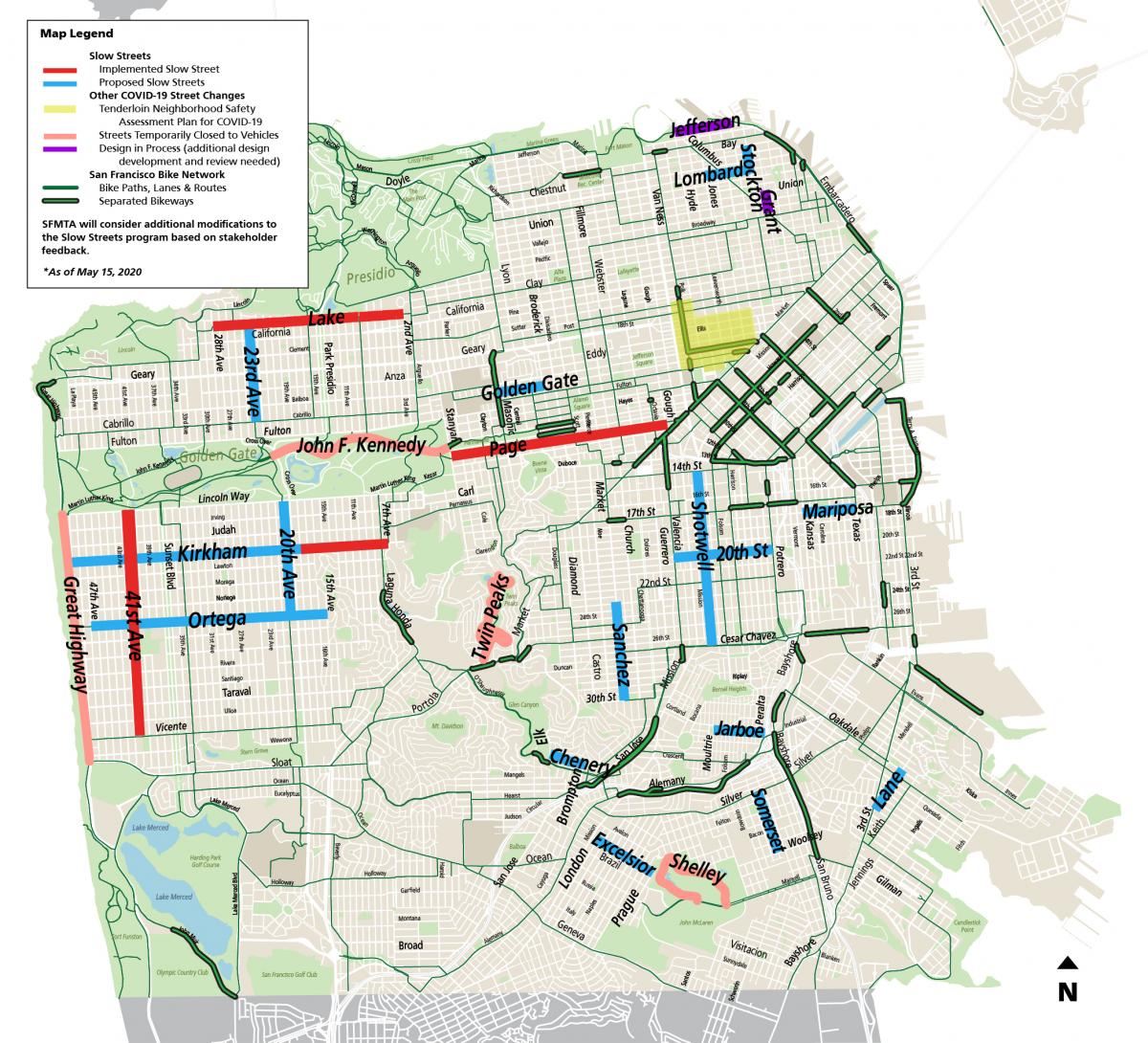
  • 20th Street, from Valencia to Potrero 
  • 23rd Avenue, from Lake to Cabrillo 
  • Chenery, from Elk to Brompton 
  • Excelsior, from London to Prague 
  • Golden Gate Avenue, from Masonic to Divisadero 
  • Jarboe, from Moultrie to Peralta 
  • Lane, from 3rd Street to Oakdale 
  • Lombard, from Jones to Stockton 
  • Mariposa, from Kansas to Texas 
  • Sanchez, from 23rd to 30th  
  • Shotwell, from 14th Street to Cesar Chavez 
  • Somerset, from Silver to Woolsey  
  • Stockton, from Bay to Lombard 

Map of Slow StreetsSFMTA’s implemented (red) and proposed (blue) Slow Streets corridors. 

The first four Slow Streets corridors we implemented (41st Avenue, Kirkham, Lake, and Page) total 11 lane miles, and the remaining first phase of planned Slow Streets total 9 lane miles. These thirteen new corridors add another 14 lane miles of streets prioritized for walking and biking, for a complete Slow Streets network of 34 lane miles.  

Slow Streets are one element of the city’s efforts to provide physical distancing as people make essential trips. They create more space for those traveling on foot or by bicycle while still making sure people who live on the streets, and emergency vehicles have full access. Signage restricts through vehicle traffic, and SFMTA has worked with navigation map providers to re-route through traffic through these corridors on their apps. 

How were these streets selected? 

SFMTA staff gathered the most frequently suggested corridors. Streets were initially screened for conflicts with Muni service, primary public safety routes, and commercial loading zones. Additional screening criteria included intersection geometry and sight distances, topography, surrounding land use, connections to the bicycle network and open space network, and reductions in Muni service.  

The most requested Slow Streets corridors include Sanchez Street and Shotwell Street in the Mission, Chenery Street in Glen Park, and Golden Gate Avenue in Western Addition. We also solicited corridor suggestions from community-based organizations and District Supervisors’ offices and included recommendations from previous community planning efforts. 

Due to the multiple uses of our roadways, not all streets are good candidates for Slow Streets. For example, Jefferson and Grant streets are locations with high commercial delivery needs and complex emergency vehicle access needs. We are working with adjacent stakeholders and other City departments to create a detailed plan that allows for increased pedestrian access, business recovery, and complex access needs during the current public health crisis. 

What is the Tenderloin Neighborhood Safety Assessment and Plan? 

We heard a lot of interest in adding more Slow Streets to the Tenderloin area. At the same time, last week Mayor Breed announced the release of the Tenderloin Neighborhood Safety Assessment and Plan for COVID-19 -- a comprehensive report of the current conditions in the Tenderloin and a block-by-block plan for addressing those challenges.  

The Tenderloin Plan is part of the City’s broader efforts to address the public health crisis in San Francisco and among people who are experiencing homelessness. We noted the area on the map above and will support other departments in our capacity, including adding things like Slow Streets where appropriate.  

What is next? 

We are currently working to schedule the implementation of the additional Slow Streets corridors with the input from neighborhoods, community groups, and elected officials. SFMTA is balancing the need for Slow Streets in each district and will share regular updates on our progress and plans.  

Please remember to use Slow Streets for essential trips. They are not neighborhood gathering points. We also encourage everyone to bring a face covering and maintain proper physical distance from people outside their households. We are continuously monitoring this program for its effectiveness and want to make sure it is being used properly. 

For updates and additional information on the SFMTA’s Slow Street Program, visit the program webpage at SFMTA.com/SlowStreets. Please also visit SFMTA.com/COVID19 for the latest agency updates about our COVID-19 response. 
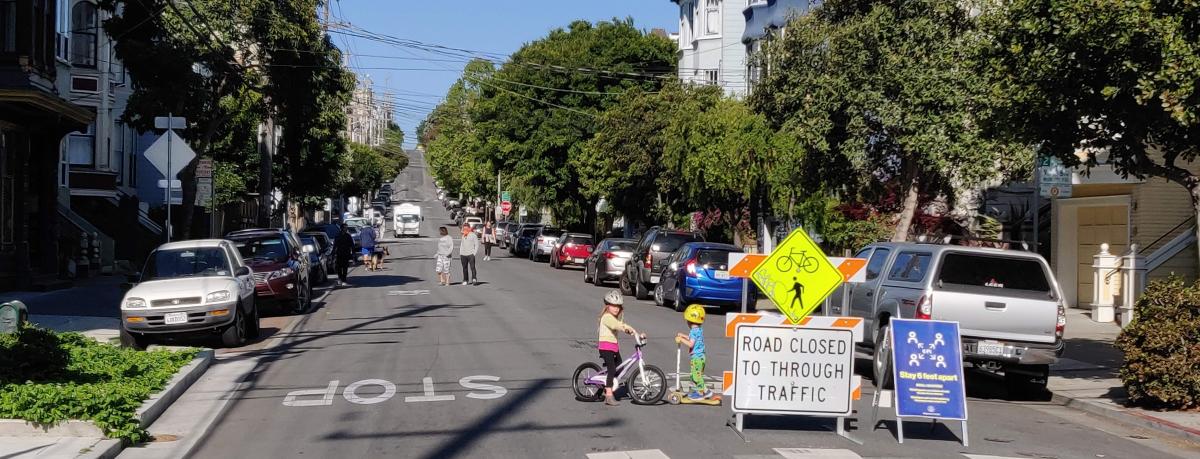
Slow Streets on Lake Street with kids on bikes


Published May 16, 2020 at 09:26PM
https://ift.tt/2LA60hm

Thursday, May 14, 2020

Select Increases to Muni Service Frequency Starting May 16

Select Increases to Muni Service Frequency Starting May 16
By

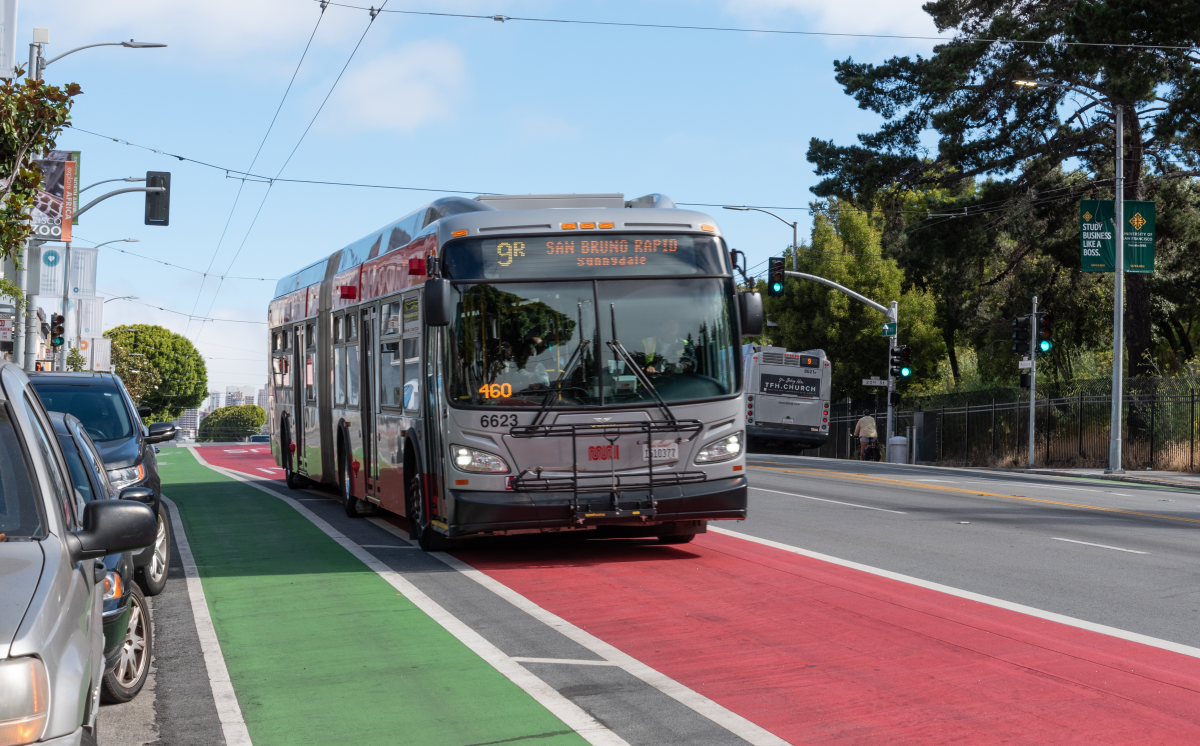
9R San Bruno Rapid travels on Potrero Avenue

Beginning Saturday, May 16, the SFMTA will increase the frequency on a number of lines in Muni’s existing COVID-19 Core system and reinstate the 9R San Bruno Rapid. This more frequent service will continue to support essential trips in San Francisco and address crowding in several of our routes, allowing for better physical distancing.  

We are able to deliver these changes because our staffing availability has improved, and we have implemented additional bus cleaning programs. These changes allow us to make service frequency increases to our COVID-19 Core service network

Public health orders require Muni to limit capacity on our vehicles to provide enough space onboard to physically distance from others. By having buses arrive more frequently on routes experiencing higher passenger volumes, we can provide customers more room to physically distance. These improvements allow Muni to continue to support essential trips that cannot be made in other ways.  

Ridership data is facilitating precise decision-making about where to increase the frequency of Muni service.  Weekday frequencies on the following routes will be improved by two to four minutes, and they will all operate at frequencies of 10 minutes or less:  

  • 8 Bayshore 
  • 14R Mission Rapid 
  • 22 Fillmore
  • 38R Geary Rapid 
  • 49 Van Ness/Mission 
  • N Bus  
  • T Bus 

The 14 Mission Owl frequency will be improved by 10 minutes for both weekday and weekend service and will operate approximately every 20 minutes from 10:00 pm to 5:00 am. 

On weekdays, the 9R San Bruno Rapid will also be restored to support physical distancing, help alleviate crowding on the 9 San Bruno line and add more frequent service to Zuckerberg San Francisco General Hospital. The 9R San Bruno Rapid and 9 San Bruno lines will resume their regular routing. When the 9R San Bruno Rapid is in service to McLaren Park on weekdays from 7:00 am to 6:00 pm, the 9 San Bruno will terminate on Bayshore at Visitacion. At all other times, the 9 San Bruno will go to McLaren Park. Further details are provided in our transit and travel update

  • 9R San Bruno Rapid: Frequency approximately every 10 minutes from 7:00 am to 6:00 pm (Weekdays only) 

  • 9 San Bruno: Frequency approximately every 10 minutes from 5:00 am to 10:00 pm (Weekdays and weekends) 

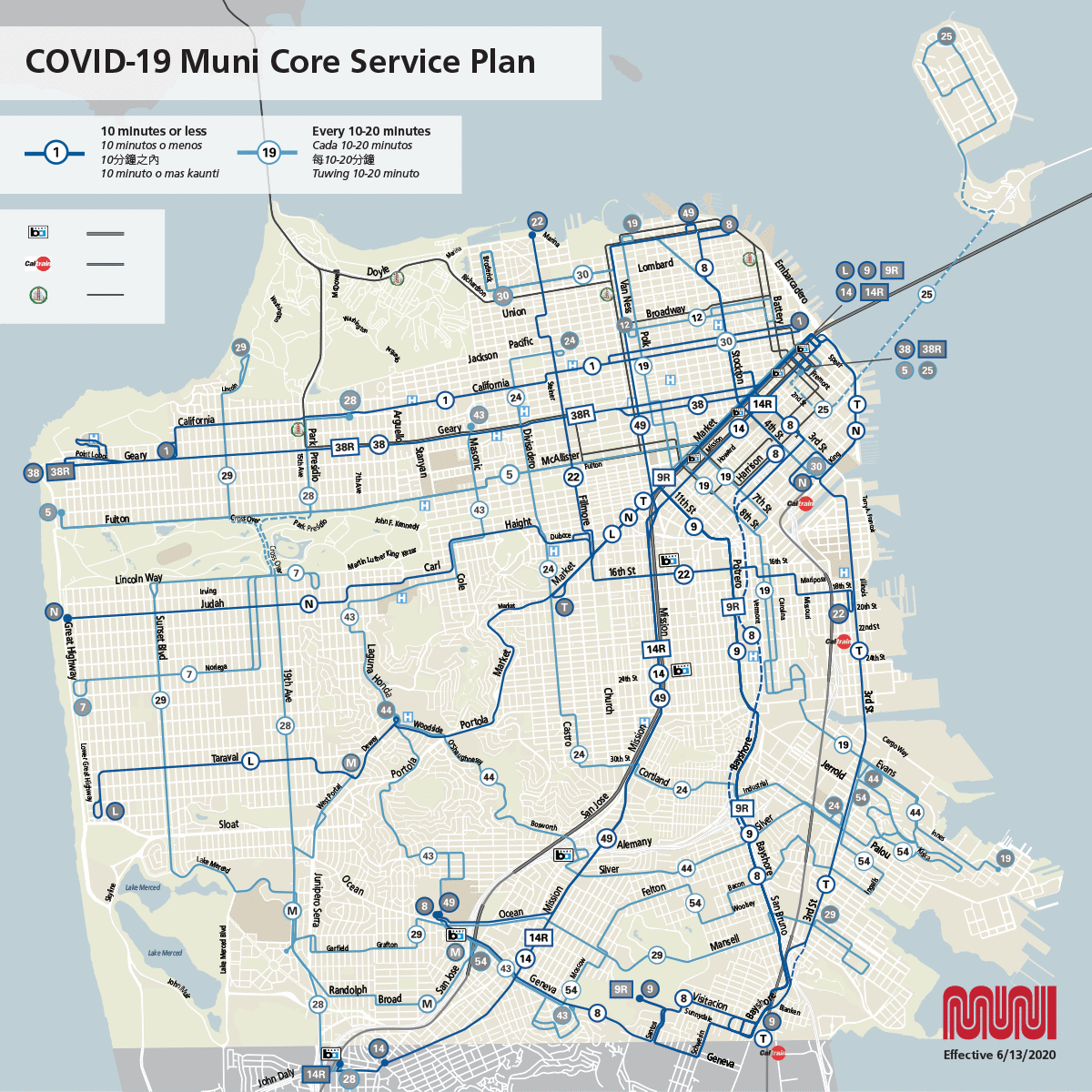
Map of Core Service that will be in effect as of Saturday, May 16: 

COVID-19 Muni Core Service Map

The modified COVID-19 Core Service Plan is in support of essential trips that cannot be made in other ways. All San Franciscans are helping us maintain adequate space on buses for physical distancing by continuing to stay at home except for essential trips. If you need to make an essential trip, please use an alternate form of transportation whenever possible – walking, biking or driving – to save a seat on Muni for those who don’t have other options.  

If you do need to travel on Muni, give yourself extra time. You may need to wait longer for a bus with available space for physical distancing. Masks or face coverings are required on Muni. To avoid getting passed up, cover your nose and mouth with a mask or other facial covering and give the operator a friendly wave to be sure they see you. Remember, your trip may now include transfers and a longer walk, and your fare is good for two hours across multiple buses. 

Visit SFMTA.com/COVID-19 for the latest information about Muni routes in service or to explore other ways to get around the city. 


Published May 14, 2020 at 10:55PM
https://ift.tt/2WQ70mA

Wednesday, May 13, 2020

Everyday Heroes: Taxi Driver Corey Lamb

Everyday Heroes: Taxi Driver Corey Lamb
By Sarah Hellman

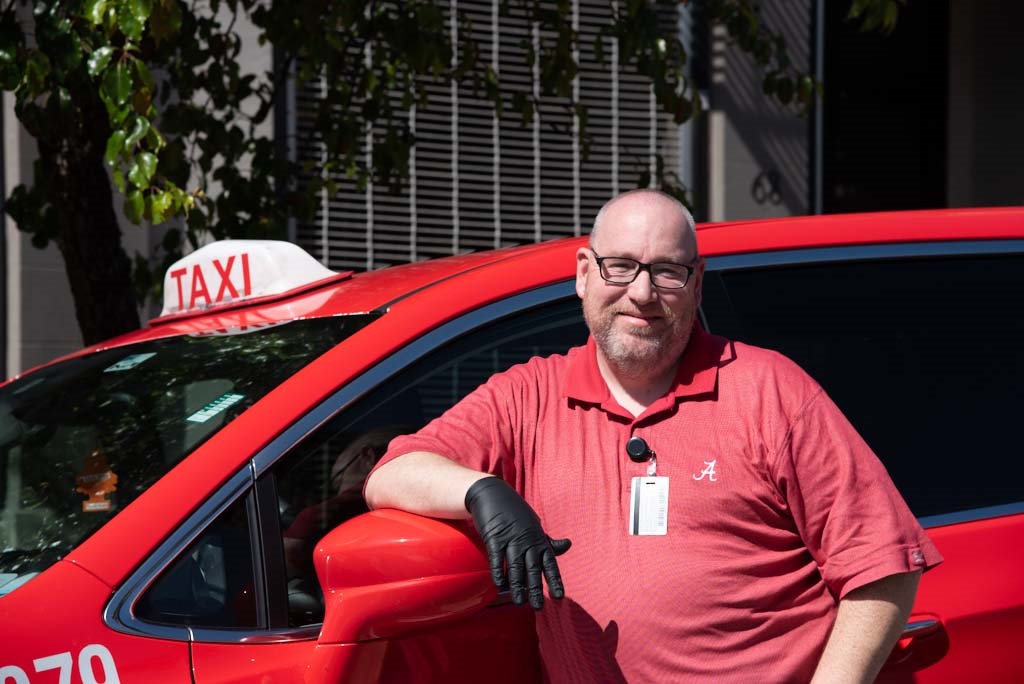
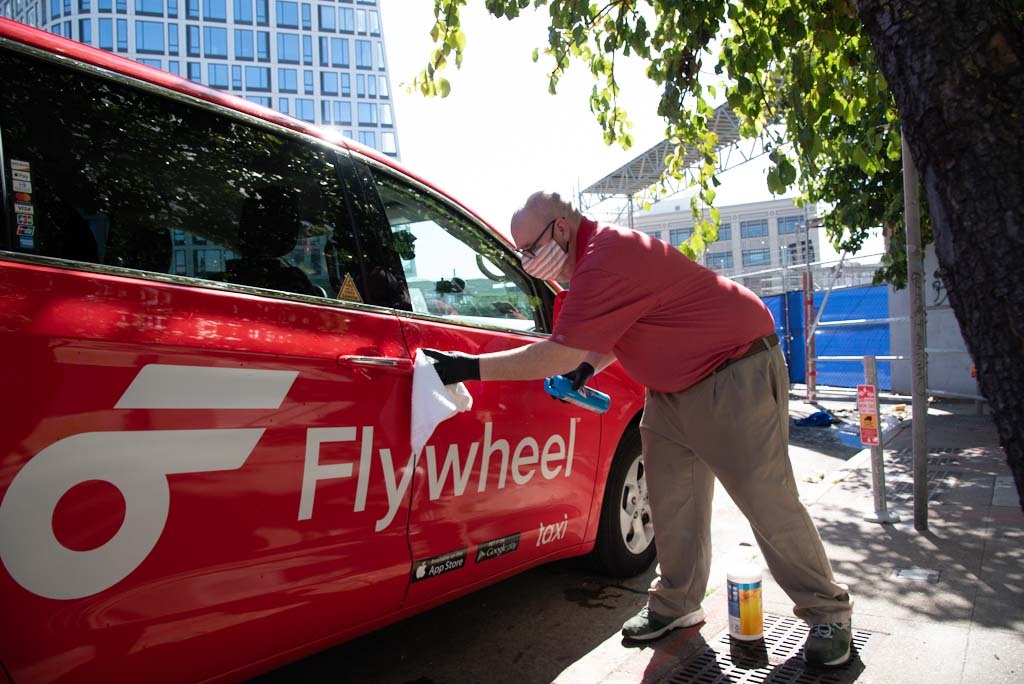
Picture of taxi driver Corey Lamb

Corey Lamb shown without his face mask for the purposes of this photo only.

Corey Lamb is a veteran taxi driver with over 10 years of experience, and one of our unsung heroes. Corey provides at least 50 trips each month to wheelchair users who are unable to use Muni's accessible but regular fixed-route service. And during the shelter in place order, he has been actively transporting patients to needed medical appointments — patients like San Francisco resident Amelia Sison.

Lamb is representative of the many taxi drivers who are working hard during this health emergency to serve the needs of our most vulnerable residents who need to take trips for essential services.

For Sison, Lamb is her lifeline to the community. Since her necessary medical treatments began last year, Lamb has been her regular taxi driver, transporting her at least three times a week to and from appointments.

Awarded the 2019 Systemwide Paratransit Driver of the Year, Lamb has been an instrumental part of providing transportation to many seniors and individuals with disabilities through his participation in the city's ramp taxi program.

San Francisco launched the ramp taxi program in 1994 to ensure that wheelchair users had access to on-demand taxi service. Dedicated ramp taxi drivers like Lamb have made the city's ramp taxi program a leading model among paratransit programs in providing on-demand transportation services to wheelchair users.

For Lamb, this job isn't just about driving his passengers to their destinations — he has had the opportunity to meet people from all around the world. In 2019, he's met people from Canada, Spain, the UK, Sweden, India, Australia and from around the United States – all of whom use a wheelchair as their primary mobility method. Through his work, Lamb has assisted this community's independent lifestyle, treating each passenger with dignity and respect.

Know another driver or frontline SFMTA worker who’s doing a great job? Acknowledge those going above and beyond. Please share a photo (with their permission) along with their name and a quick description to  SFTaxi@SFMTA.com. Some examples are:

  • An everyday hero doing extra cleaning at your division
  • Teammates getting creative to practice social distancing
  • Something special a colleague did to support a team member during this challenging time

Picture of taxi driver corey lamb cleaning his vehicle


Published May 13, 2020 at 11:35PM
https://ift.tt/2Z1J2HU

Tuesday, May 12, 2020

Memorial Day Weekend Street Closures at Geary and Steiner to Remove Pedestrian Bridge

Memorial Day Weekend Street Closures at Geary and Steiner to Remove Pedestrian Bridge
By Amy Fowler

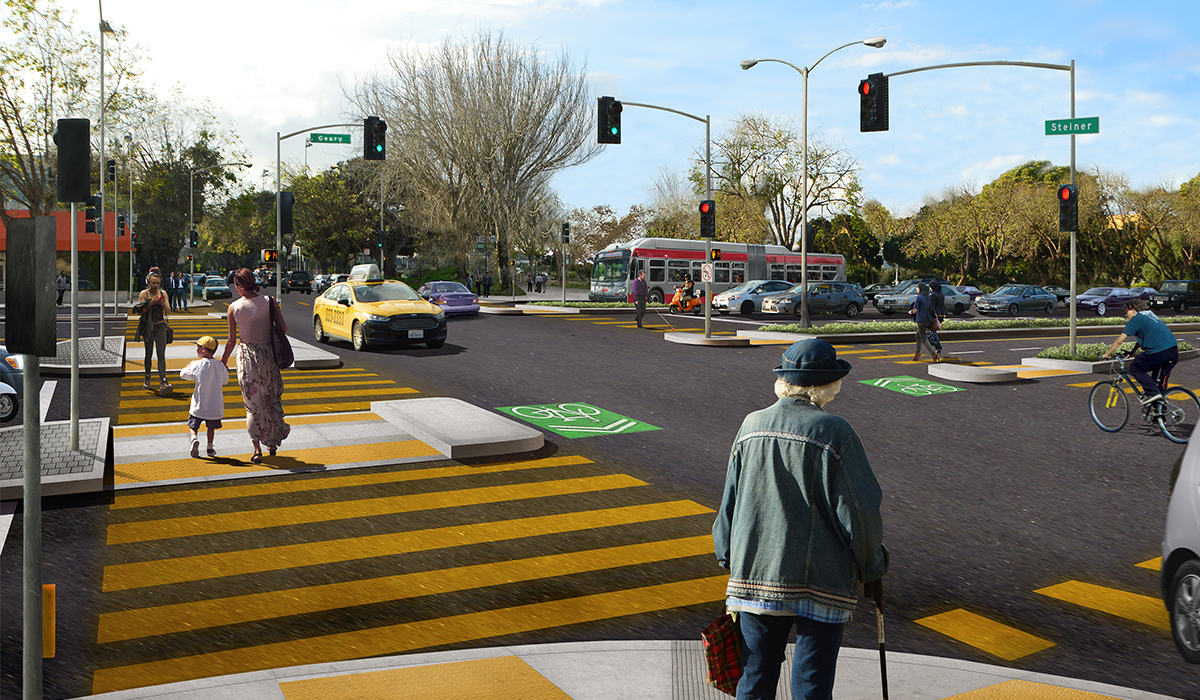
Rendering of the future Geary and Steiner intersection, with the Steiner bridge removed and improved crosswalks and medians

The future of Geary and Steiner, with the Steiner bridge removed and improved crosswalks and medians

The skyline on Geary Boulevard is about to change: this Memorial Day weekend, the pedestrian overpass at Geary and Steiner will be permanently removed.

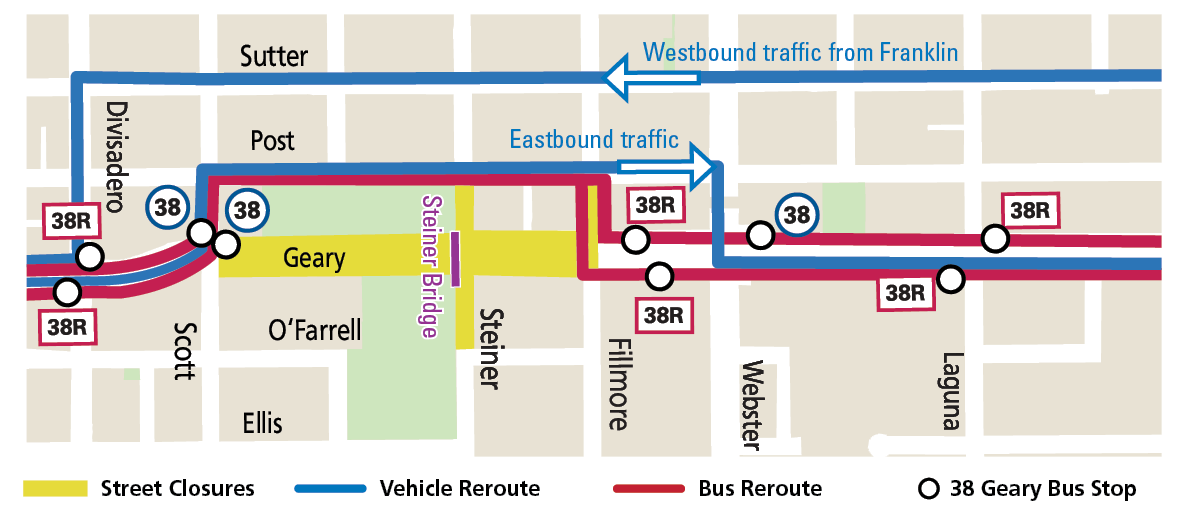
Beginning at 8:00 p.m. Friday evening on May 22, the area around Geary Boulevard and Steiner Street will be closed to traffic while crews work to demolish the bridge. Work will continue for 24 hours a day until the demolition is completed, which could continue as late as Monday evening. During that time, vehicles will be rerouted and bus stops will be relocated. If you’re driving or taking Muni in the area, please allow extra travel time to get to your destination.

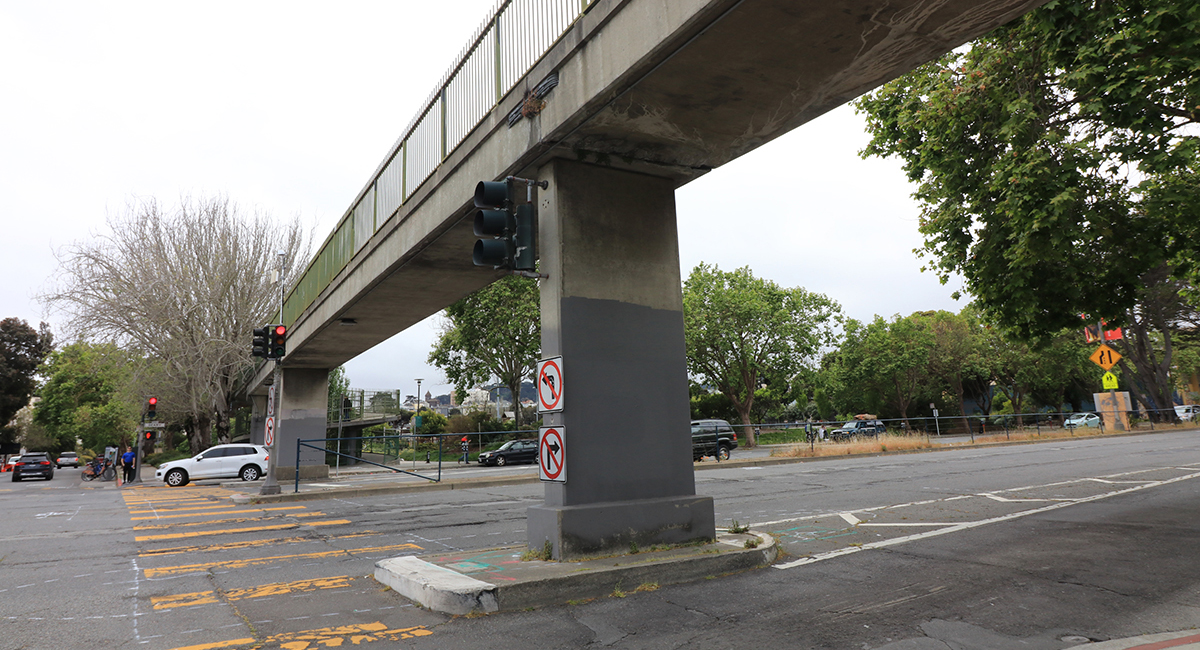
While removing the overpass may sound like a bridge too far, in this case it’s a bridge too steep. The Steiner pedestrian bridge was built in 1962, with 11-17% ramp slopes that far exceed the 5% limit that was later established by the Americans with Disabilities Act. The bridge’s support piers also reduce visibility of people crossing at the intersection. In place of the overpass, the SFMTA will be improving conditions for how people already prefer to travel—currently, over 80% of people on foot or wheelchair cross Geary and Steiner at street level.  

Image of existing conditions at Steiner and Geary

Get info about detours, bus stop changes and more at the Steiner bridge webpage

Later this year, the areas where the bridge ramps were will be repurposed for the adjacent San Francisco Recreation and Park sites. Hamilton Recreation Center will have a new stairway added at the northwest corner of Steiner and Geary, along with an expanded patio and new landscaping. The Raymond Kimbell Playground grassy area will also be expanded including a paved pathway rebuilt towards the intersection.

Towards the end of the project in 2021, after utility upgrades and street repaving are completed, a new surface crosswalk will be added on the east side of the intersection at Steiner. The existing crosswalk on the west side of the intersection will also be improved with larger pedestrian medians.

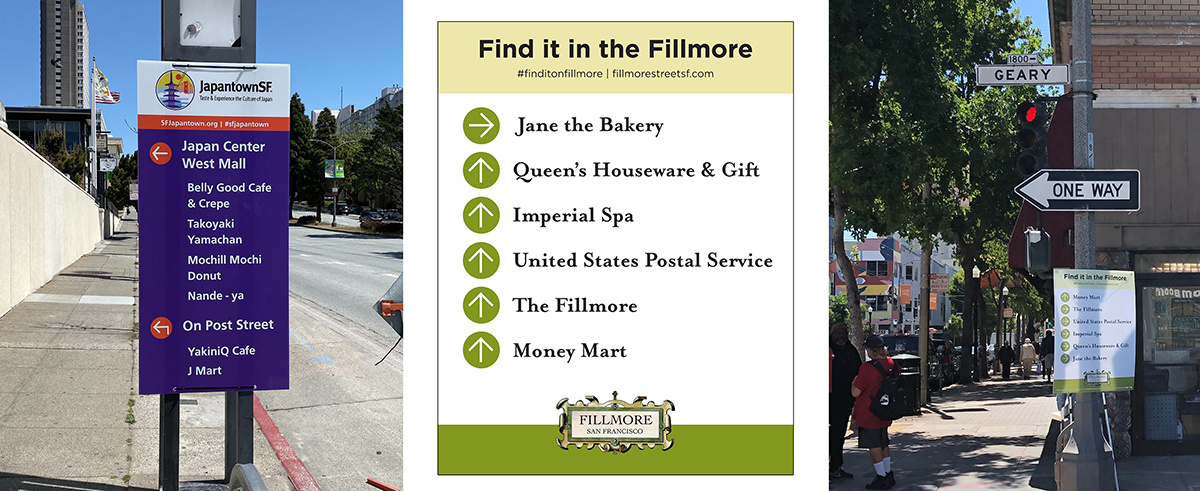
Image of wayfinding signs for Japantown and the Fillmore to support businesses during the bridge demolition
Local businesses and residences will remain accessible during the work, and wayfinding signs are being posted to help small businesses that are still open during the shelter in place order

Those hoping for a spectacle may be disappointed—the bridge won’t be imploded, but instead carefully dismantled and removed by Silicon Valley Demolition using two large five-axle mobile cranes, flatbed trailer trucks, and other large construction equipment.The spiral and folded ramps will be demolished in-place using hydraulic concrete processors to break up the structures; debris will be loaded into dump trucks for transport off-site. Crews are prepared to finish demolishing the bridge over the weekend, rain or shine.

The bridge removal is being overseen by San Francisco Public Works and is part of the Geary Rapid Project, which aims to improve bus service and pedestrian safety on the Geary corridor between Stanyan and Market streets. And it happens to correspond with another milestone—construction of the Geary Rapid Project has just reached its halfway mark and is expected to be completed on schedule in summer 2021. 

Reroutes and Bus Stop Relocations

Map of reroutes and bus stop changes during the bridge removal work
Map of detours and bus stop relocations during the bridge removal that starts Friday evening, May 22

Taking Muni

  • 38/38R Geary buses will be rerouted to Post Street around the work zone and some bus stops will be temporarily relocated nearby. Look for “Board Here” signs.

Driving and Parking

  • Streets will be temporarily closed to through traffic on Geary between Scott and Fillmore, on Steiner between Post and O’Farrell, and on Fillmore between Geary and Post streets with local access only.
  • Vehicles will be rerouted to Sutter Street (westbound) and Post Street (eastbound).
  • Some parking will be restricted within the street closure areas, at the relocated bus zones and at intersection corners along the detour route.

Walking or Bicycling

  • Pedestrian detours will be provided around the work zone. People crossing Geary Boulevard north/south will need to cross at Scott or Fillmore Street.
  • Cyclists can cross Geary at Webster Street.
  • The Bay Wheels bike share station at Raymond Kimbell Playground will be closed.


Published May 13, 2020 at 02:39AM
https://ift.tt/35W5UcV

Friday, May 8, 2020

Your Market Street Muni Service FAQs - Answered

Your Market Street Muni Service FAQs - Answered
By Mariana Maguire

Even with temporarily reduced service and lower ridership across the Muni network amid the COVID-19 citywide stay-at-home health order, there are still multiple Muni Core Service routes overlapping along Market Street.

We’ve rolled out new tools to provide important information to customers who are still taking Muni for essential trips, including:

  • The COVID-19 Ambassador Program along Market Street
  • New wayfinding signage for bus routes along Market Street
  • New signage about physical distancing and face coverings
  • Multilingual onboard audio announcements and PSA car cards, social media campaigns, and a dedicated website at SFMTA.com/COVID19

Even so, we know our customers still have questions — read on to learn a bit more about our most frequent inquiries:

Which routes are operating on Market Street?

Since bus service replaced Muni Metro and light rail service to help us consolidate resources, the routes currently in operation along Market Street include:

  • 5am-10pm: L Bus, N Bus, T Bus, 9 San Bruno, 5 Fulton, 38 Geary and 38R Geary Rapid
  • 10pm-5am Owl: L Owl, N Owl, 38 Geary

Metro buses are only serving major stops - both island and curbs - on Market so they can move across the city quickly and serve the most riders.

Where are buses stopping along Market Street?

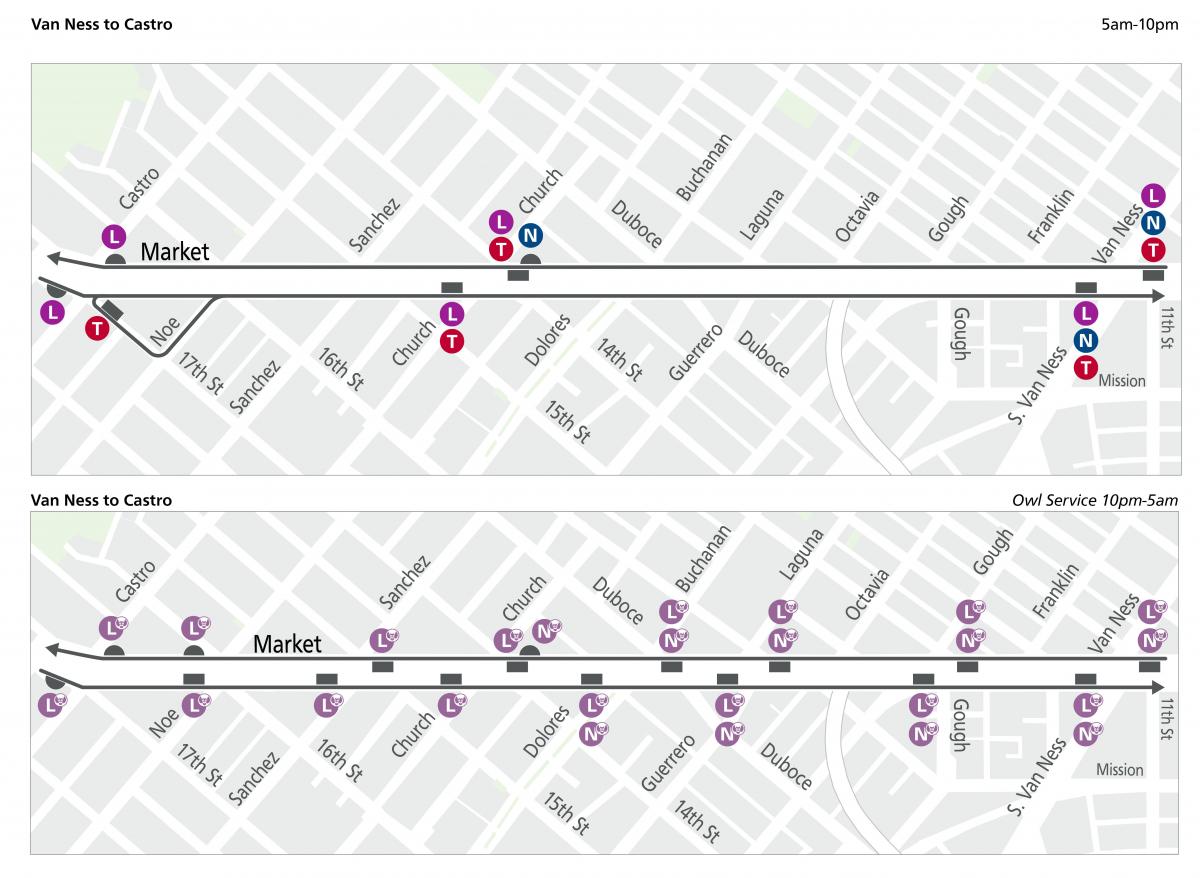
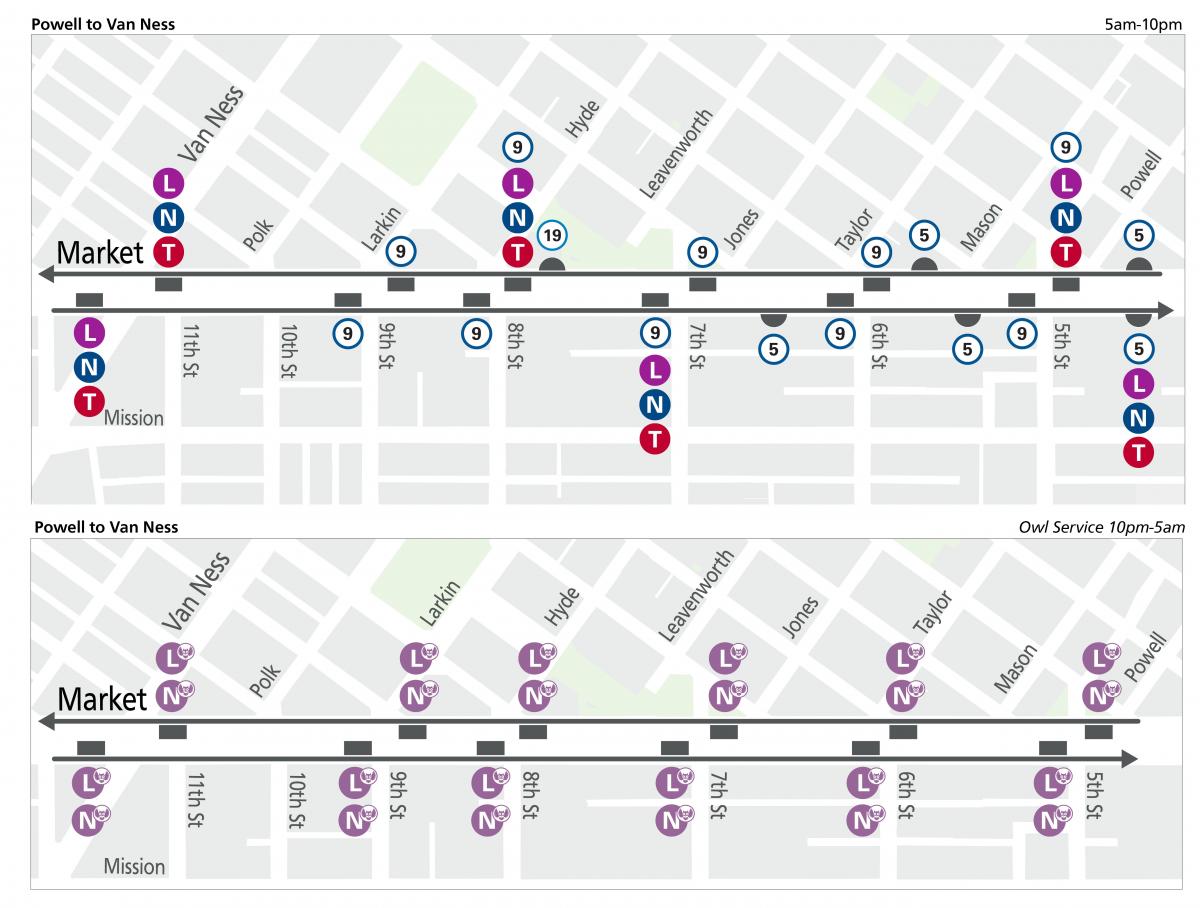
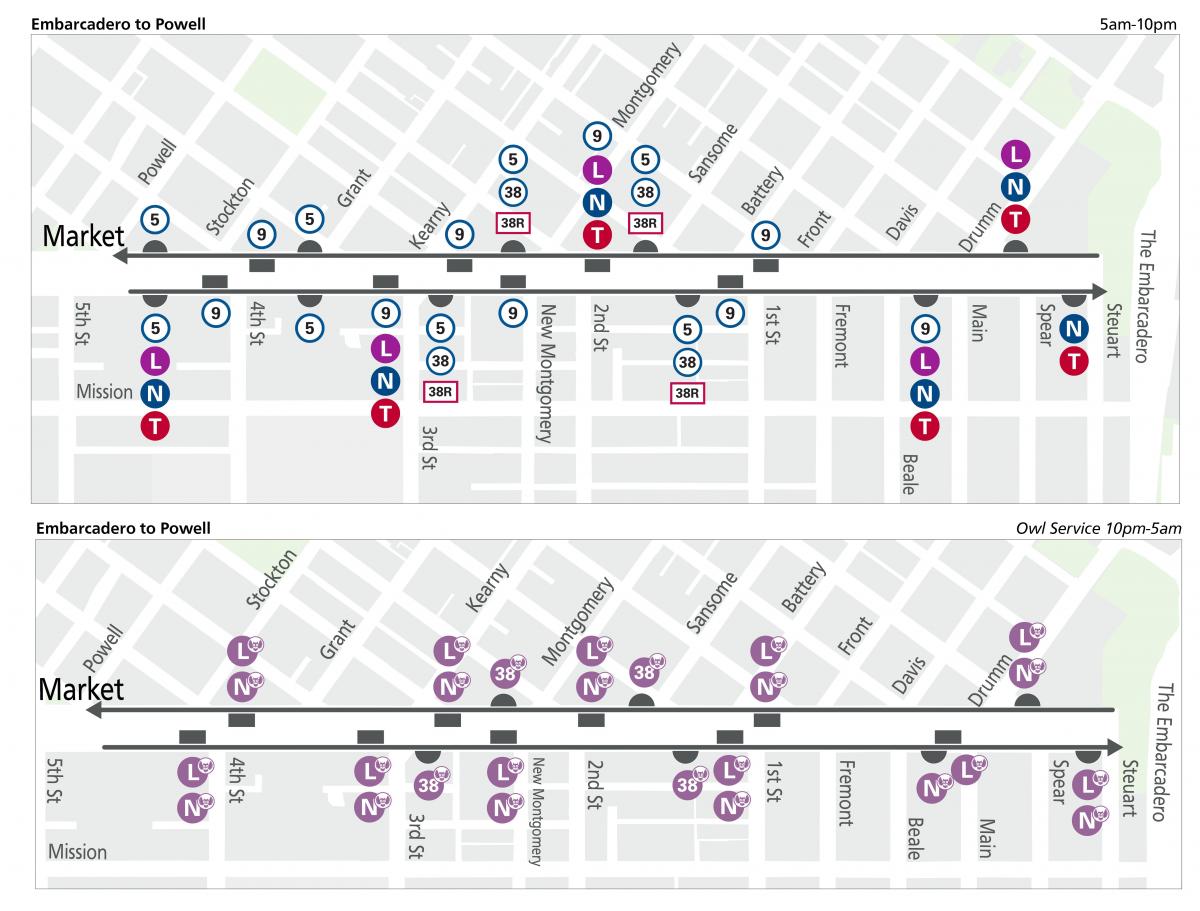
To help clear up where each bus route is supposed to stop, we’ve posted new wayfinding signs featuring the map segments below, showing customers exactly where they can find their bus.

Some bus stops are only served by Owl buses only right now, so check the wayfinding maps carefully. Some stops may only be in service after 10:00 p.m.

Wayfinding Muni stop maps for day and owl service from Castro to Van Ness.

Wayfinding Muni stop maps for day and owl service from Castro to Van Ness. Rectangles indicate boarding islands. Half circles indicate curb stops.

Wayfinding Muni stop maps for day and owl service from Van Ness to Powell.

Wayfinding Muni stop maps for day and owl service from Van Ness to Powell. Rectangles indicate boarding islands. Half circles indicate curb stops.

Wayfinding Muni stop maps for day and owl service from Powell to Embarcadero.

Wayfinding Muni stop maps for day and owl service from Powell to Embarcdero. Rectangles indicate boarding islands. Half circles indicate curb stops.

Why aren’t there more buses in service?

With fewer operators, car cleaners and maintenance staff available during the shelter-in-place, Muni service has been temporarily reduced to focus on core routes for people’s essential trips only. Based on data from customer travel patterns we’ve observed during the COVID-19 shelter-in-place, these routes represent the busiest lines with the highest demand. This core service provides connections to essential services like hospitals and grocery stores and is informed by Muni’s Equity Strategy to provide transportation for those with the fewest options.

Some routes are running approximately every 10 minutes or less, while others run every 10-20 minutes.

We will continue to make updates to Muni’s core service based on ridership trends, staffing availability, and community feedback.

Who should be riding Muni while we shelter in place?

Muni is currently operating for essential trips and should be used only if you don’t have another option. This is part of our effort to comply with the shelter-in-place order, support physical distancing and adjust to staffing availability. If you are an essential worker traveling to and from your essential work, or if you are taking an essential trip for health services, social services or food/grocery shopping, and you don’t have another way to make your trip, Muni Core Service is here for you.

If you are able to take other forms of transportation for any of these trips – such as walking, bicycling, or by taxi using our new Essential Trips Card program – we encourage you to do so. Every seat you save helps someone who needs it most right now and helps us maintain physical distancing on board our buses.

Why do some buses skip pickups?

Our priority is to keep core service going for customers to reach essential jobs and make essential trips. We are also a key agency in the City’s efforts to “flatten the curve” of COVID-19 transmission by encouraging physical distancing and requiring face coverings. Operators may bypass stops if their buses are getting too full for customers to maintain physical distance on board. They may also bypass stops if customers are not wearing face coverings -- so be sure to wear your mask or face cover over your nose and mouth, even while you are waiting for the bus. We know this is hard for customers, and we appreciate your understanding as we get through this together.

How can Muni customers keep physical distance on Market Street?

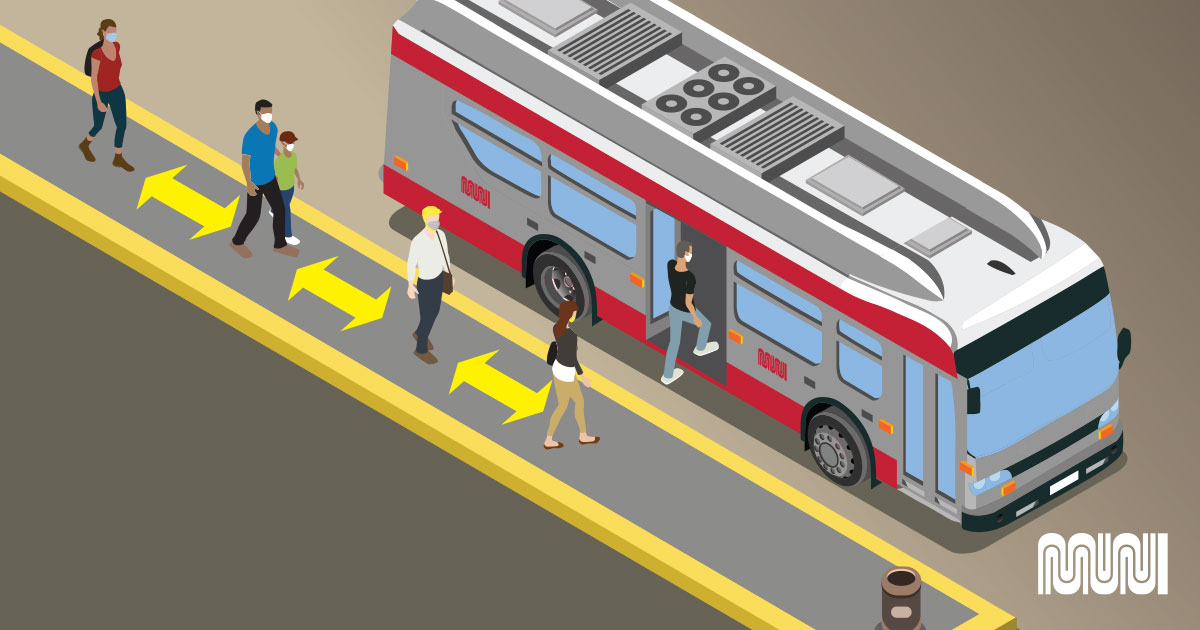
While you wait, use ground markings at Market Street bus stops to keep you physically distanced at stops. If you don’t see any pavement markings at your stop, be sure to allow about six feet between you and other customers.

ADA and non-ADA Pavement decal markings for physical distancing at bus stops on Market Street.

Newly installed ADA and non-ADA Pavement decal markings for physical distancing at boarding islands on Market Street.

When your bus arrives, leave space as people are exiting the bus until it’s your turn to board. If a bus looks about half full, consider waiting for the next bus to help others maintain distance on Muni.

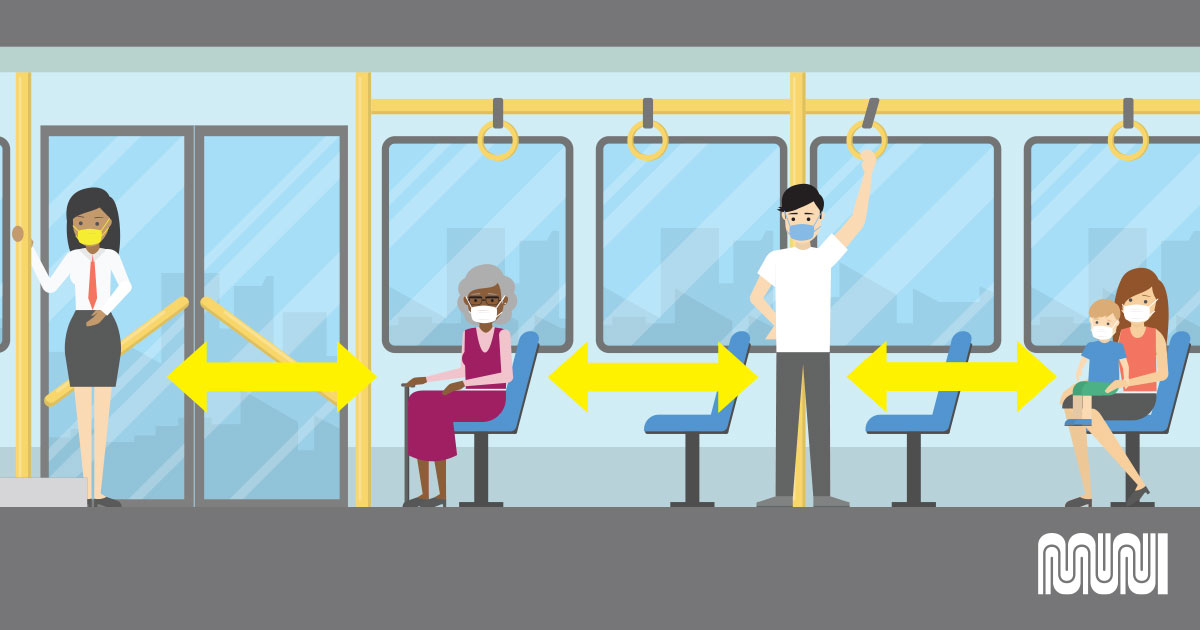
While you ride, keep as much physical distance as possible on board. We ask that customers use their best judgement and remember that if you are feeling crowded, please wait for the next bus.

Graphic depicting physical distancing onboard Muni buses.

Graphic demonstrating physical distancing onboard Muni buses.

Do Muni customers have to wear face coverings?

YES! As of April 22, anyone riding Muni is required to wear face coverings. This is an official citywide health order. Your mask protects others, and their masks protect you. It’s an important way to prevent the transmission of COVID-19. Only board Muni if you are wearing a face covering. Wear your face covering when waiting for Muni too! 

We have observed that most of our customers have taken this order seriously and are wearing face coverings at bus stops and onboard Muni buses. We appreciate everyone who has responded by doing their part. Thank you for wearing your masks, scarves and bandanas over your nose and mouth on Muni.

Sign describing the requirement to wear face masks or coverings.

Sign describing the requirement to wear face masks or coverings.

Which doors should customers use to board Muni buses?

Use the rear doors only. The front doors are for wheelchair access and for people who need the kneelers to board. Remember, give people space as they are exiting the bus.

Image depicting rear door boarding on Muni bus.

Graphic showing rear door boarding on Muni buses.

Why are streetcars and/or Light Rail Vehicles (LRVs) running sometimes?

These vehicles are not currently in service, but you may see some running along Market Street for maintenance reasons.

Got a burning question? Let us know.


Published May 09, 2020 at 04:41AM
https://ift.tt/2yDu2F2

Monday, May 4, 2020

Director of Transportation Report: April 21, 2020

Director of Transportation Report: April 21, 2020
By

Slow Streets closed sign and N Judah shuttle

In this week's Director's Report from the SFMTA Board of Director's Meeting, Jeffrey Tumlin gave updates on the following topics:

  • The agency’s ongoing response to COVID-19
  • Ambassador program with agency staffing assisting transit in monitoring bus ridership along Market Street
  • How the Essential Trip Program is helping to subsidize taxi use for older customers and those with disabilities
  • Launch of the Slow Streets Program that will provide a network of streets that prioritize other modes besides public transit for essential trips while still allowing local vehicle traffic.
  • Caltran’s US 101 Alemany Replacement Project shifting work to begin earlier on April 25
  • Status on the closure of the Great Highway following an early April sand event
  • Third Street Bridge and bicycle traffic

The SFMTA Board of Directors generally meets on the first and third Tuesday of each month at 1 p.m. in Room 400, City Hall. The meeting is open to staff and the public, or can be livestreamed through SFGovTV.


Published May 05, 2020 at 02:35AM
https://ift.tt/2YAlnOy

Friday, May 1, 2020

M Bus Community Shuttle Starts Service Monday 5/4

M Bus Community Shuttle Starts Service Monday 5/4
By Erin McMillan

M Bus to Balboa Park

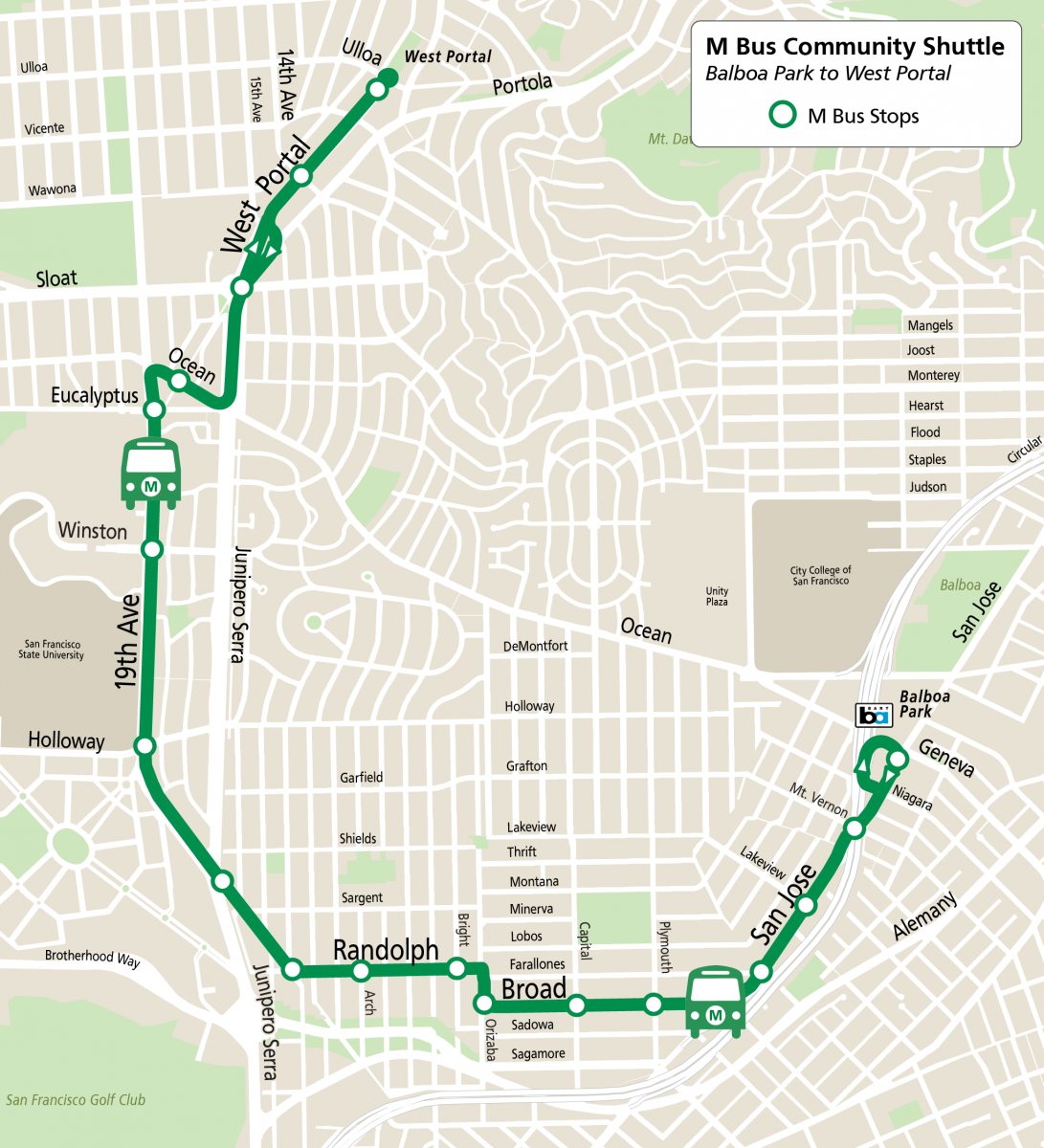
Starting Monday, May 4, the M Bus will return to partial service as a “Community Shuttle” between Balboa Park and West Portal stations. This service update is based on ridership trends, staffing availability, and community feedback. It has strong support from District 11 Supervisor Safai as a way to improve transit connections in the southwestern area of the city. The modified M Bus Community Shuttle route will provide better access for essential trips in the Ocean View, Merced Heights and Ingleside neighborhoods and to the transit hubs of West Portal and the Balboa Park. Serving stops on weekdays only from 6 a.m. to 9 p.m., the M Bus frequency will be approximately every 20 minutes.

M Bus Community Shuttle Route

Since April 8, Muni has been operating a COVID-19 Core Service Plan to support essential trips that cannot be made any other way. With fewer operators, car cleaners and maintenance staff available during the shelter-in-place, Muni service has been temporarily reduced. The initial network and subsequent changes are informed by data on where ridership is highest, our Muni Equity Strategy to provide transportation for those with the fewest options, locations of essential services like hospitals and groceries, and to provide coverage across the city.

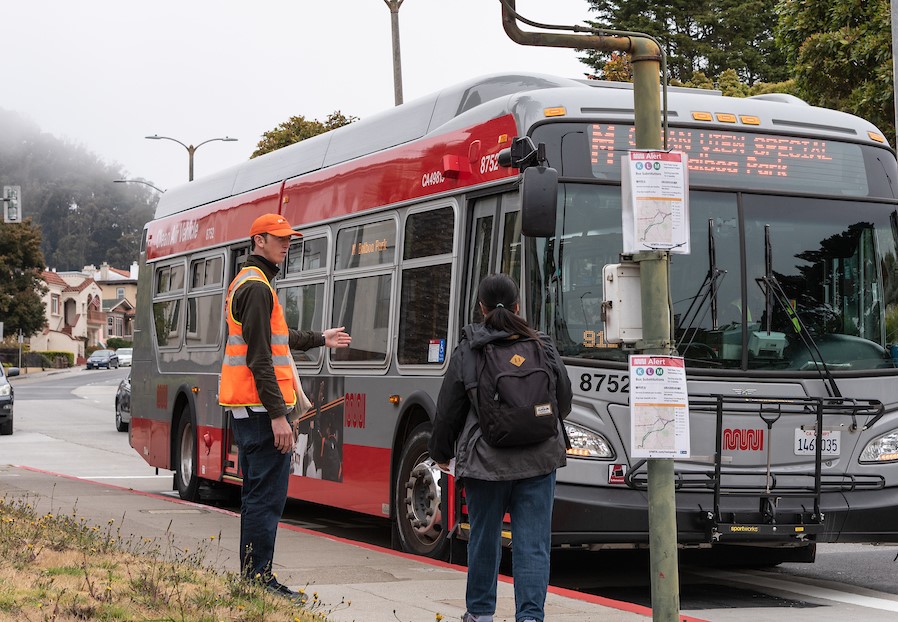
Muni still serves approximately 100,000 passengers a day for essential trips. We are asking all San Franciscans to help us maintain adequate space on buses for physical distancing by staying at home except for essential trips. Staying home or walking, biking or driving instead saves a seat on Muni for those who don’t have other options. You may see some of our staff at select bus stops helping to reinforce this message to our customers.

If you do need to travel on Muni, give yourself extra time. You may need to wait longer for a bus with available space for physical distancing. Masks or face coverings are required on Muni. To avoid getting passed up, cover your nose and mouth with a mask or other facial covering and give the operator a friendly wave to be sure they see you. Remember, your trip may now include transfers and a longer walk, and your fare is good for two hours across multiple buses.


Published May 02, 2020 at 03:15AM
https://ift.tt/2WgYRqZ

Photo Exhibit Event: Vintage Bus Display and Tour

Photo Exhibit Event: Vintage Bus Display and Tour By Jeremy Menzies Join us Saturday, Jan. 27 at a special event for our exhibit, " 1...